


AI clinical decision support is here to stay

AI in clinical decision support turns data chaos into reliable clinical insight and relevant, actionable suggestions. Imaging and labs interpretation, risk scoring, personalized recommendations, and other domain-specific tasks – AI is already tackling daily routines.
For strategic healthcare leaders, this translates into faster decision cycles, fewer escalations, more throughput, and sensible clinical efficiency.
Data volume and diversity are growing: healthcare providers are drowning in chaos but starving for clarity.
A doctor is sifting through thousands of variables per patient, yet decisions still rely mostly on outdated tools. At the same time, the stakes are rising: limited resources, staffing shortage, complex conditions, legal pressure, and ever-rising patient expectations.
Here’s where AI-based solutions are entering the game and transforming the healthcare technology we know.
What are CDSS systems?
Traditional clinical decision support – CDSS systems – is sitting at the very heart of modern healthcare delivery. They sift through large medical records, images, labs, admissions, discharges, insurance details, and protocols for consistency at point-of-care.
They do not replace the clinician, but bring the right data forward when needed.
CDSS solutions are using rule-based logic, predefined pathways, datasets gathered across sources, and more. They surface medical history & records that typically get buried within busy everyday workflows.
CDSS solutions are bringing great relief, yet despite their value, they have tangible limitations worth noting. They can’t really adapt to evidence, don’t recognize unstructured patterns, and do not learn from outcomes; however, today, we’re seeing a shift towards modernization.
Diving into CDSS systems: traditional vs advanced tools
CDSS come in two broad flavors:
| Rule-based systems | Data-based systems | |
Core approach | Experts encode if-then rules | Models learn from datasets |
| Knowledge source | Expert rules, clinical protocols, and guidelines | Large datasets: medical records, images, labs, admissions, discharges, sensor streams, and more |
| Data requirements | Works with curated rules | Needs large, labeled datasets |
| Typical algorithms | Decision tress, logic flows | Machine learning, deep learning, random forests, neural nets, and others |
| Key strengths | Predictable, controllable, and compliant with guidelines | Finds subtle, non-intuitive patterns |
| Key weaknesses | Limited to predefined scenarios | Vulnerable to data bias |
| Use cases | Interaction checks, dosing rules, guideline reminders, order sets | Imaging and labs interpretation, risk scoring, personalized recommendations, and other complex processes |
| Regulatory compliance | Easier validation and audit | Stricter validation and monitoring |
Rule-based systems
In a rule-based (or knowledge-based) solution, experts hard-code strict rules, clinical protocols, or guidelines. Just like the book with recipes your mom has used – predictable, controllable, but limited to what has been explicitly programmed by doctors.
Data-based systems: the clinical decision support AI revolution
But a data-based (or non-knowledge) solution is learning from datasets rather than human-written guidelines. They’ll leverage machine learning, deep learning, and other modern methods to identify non-intuitive patterns that might be missed by humans.
AI in clinical decision support systems for diagnosis
Unlike old-style rule checkers, CDSS software that uses AI models can learn and evolve from the data ingested. They recognize complex patterns by reading medical charts, images, labs, and more, and even handle messy, unstructured documentation (for example, clinical notes).
Recent reviews are stating: CDSS are key tools for clinicians, and integrating AI revolutionizes CDSS systems.
AI in medical diagnosis and monitoring: the market is ready
AI in healthcare support is no longer sci-fi, it’s happening at this very moment – in fact, the adoption is soaring.
- 22% of healthcare organizations had deployed AI tools by 2025 – an almost 7x increase over 2024
- Health systems lead with 27% adoption
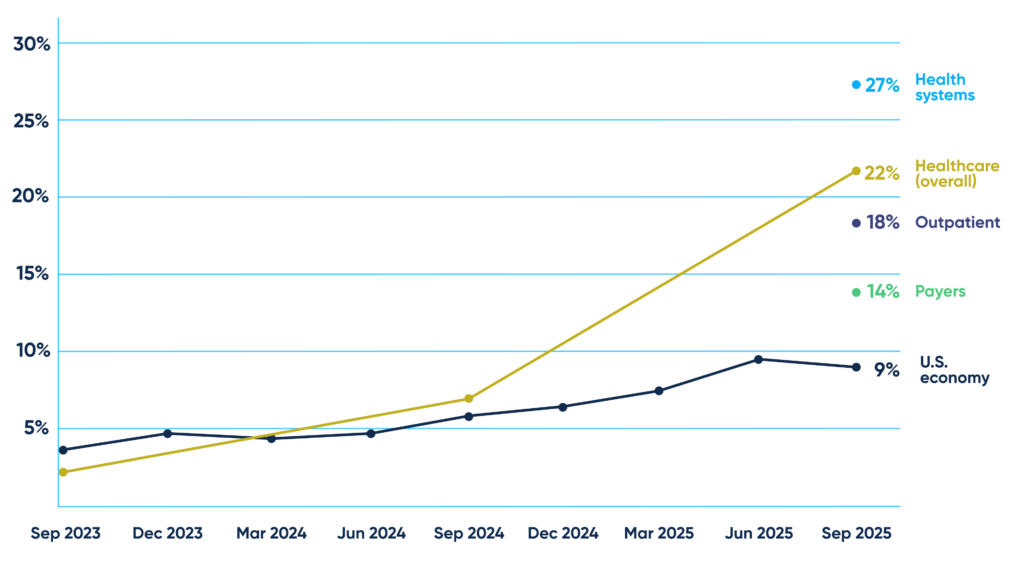
The investments also reflect the wave: AI funding has reached $1.4 billion – that’s triple the total of 2024. Major players are putting their money into innovation: Mayo Clinic, for example, has pledged $1 billion on their AI initiatives all across the organization.
On the clinical side, AI takes the root: 66% of US physicians are using AI tools – an almost 78% jump over 2023. The signs are clear: AI care is here.
AI in medical diagnosis: the opportunities
AI in healthcare support – does it really work? Actually, yes.
For instance, one study on skin cancer diagnosis showed doctors that used AI tools had much higher accuracy:
- Without those, the practitioners were only 75% sensitive and about 81% specific
- With guidance, they reached 81% sensitivity, and over 86% specificity – a significant 6-point jump, which means far fewer neglected cases
Radiology embraces artificial intelligence for identifying hidden fractures, lung nodules, or bleedings on scans. Cardiology leverages computer intelligence for detecting abnormal rhythms to prevent threatening conditions. In general, the specialties that heavily rely on imaging are the “low-hanging fruit” for recognizing visual patterns. But others aren’t lagging behind much.
The perspective: the doctors are now more capable than ever – by using AI tools, they catch the non-obvious. And, definitely, there’s more to come.
AI support going beyond clinical diagnosis: smarter treatment
AI doesn’t just highlight the problem – it suggests the solution by ingesting and processing patient information. By learning and evolving with time, it becomes much sharper and turns the standardized, uniform approaches into dynamic, patient-specific programs.
AI empowers insight-backed treatment by freeing the physician from handling the paperwork all manually.
The adoption is conquering new domains, but some are showing more readiness than others.
Drug interaction, dose adjustment, and rehabilitation are among the domains that show best outcomes:
- In one outpatient study, the practitioners that used AI-guided tools could reduce antibiotic mismatches from 14.2% to 8.9% (among women over 50, the mismatch rate dropped by 50%)
- Another case, a smart, AI-enabled insulin dosing tool has matched senior practitioners in managing blood glucose (it kept blood sugars under control as well as an experienced physician)
The global AI-CDSS market: quick growth and trends
Tech giants (Microsoft, Amazon) and mature healthcare players (Siemens, Philips) have dedicated AI initiatives. The startups are attracting venture funding.
Recent forecasts are showing explosive growth:
- Grand View Research estimates the global CDS market – CDSS and AI-CDSS solutions – has reached $5.8 billion in 2024 and may double to $10.7 billion by 2030; and that is just CDS alone
- Fortune Business Insights predicts the global AI in healthcare market to go from only $29 billion in 2024 to striking $504 billion by 2032
The signs are clear: AI-CDSS promises to become a multi-billion-dollar worth industry within the coming years. And with the attractive ROI factors – reduced error, increased accuracy, fewer expenses, greater productivity – the soon-to-bloom AI-CDSS segment is a prime area for investment.
It’s only a matter of time before every healthcare system will embrace AI innovation.
The main AI-CDSS challenges to watch
AI-CDSS offers incredible promise, but adoption also means proceeding thoughtfully: start small, scale safe. Done right, it becomes a multiplier of efficiency and provides the opportunity to meet evolving expectations; done poorly, it causes new hazards.
AI-CDSS raises multiple concerns:
- Data privacy and security
- Data bias
- Successful integration with other healthcare systems
- Ethical considerations (opaque algorithms, vague liability, and the new role of practitioners)
That’s why domain-specific expertise is critical.
As renowned healthcare-tech partners, we stress:
- Tight collaboration and communication with clinicians and nurses from day-one
- Tool alignment (an alert that does not fit the workflow will surely be ignored)
- Regular audits for errors and bias
- And, crucially, employee training
How we can help
AI-CDSS technology is being rapidly adopted: tech giants and startups are investing in dedicated AI initiatives. At the same time, they must wisely navigate practical hurdles and ethics to ensure AI fairness and consistency – AI-CDSS comes with many serious concerns.
As experts, we help healthcare organizations to integrate AI “the smart way”.
Our expertise:
- AI solutions for physiotherapy and rehabilitation
- AI solutions engineering services
- Robotic process automation services
- Hyperautomation services
Our services:
FAQ
AI-based CDSS are tools that analyze medical records, images, labs, and more to provide informed suggestions. They leverage artificial intelligence (machine and deep learning), and others to act as assistants for physicians, thus turning daily noise into insight and guidance.
AI-driven CDSS are built to minimize cognitive burden by surfacing the problem and suggesting the solution. They empower the clinician to spend less resources on research and more on care.
By detecting subtle patterns that humans easily overlook, AI raises the sensitivity and specificity in diagnosis. Such support is especially valuable within high-load settings.
By matching patient profiles to interventions most fitting, AI helps to personalize the overall patient journey. Such assistance is particularly impactful when talking about drug interaction, dose adjustment, and rehab.