


AI and data analytics in healthcare

AI and data analytics will convert your fragmented medical records into strategic, decision-grade intelligence. Medical imaging, decision support, even global population health, and, naturally, administrative automation – AI and data analytics are what you need to ditch the bottlenecks.
The payoff is faster decision cycles and research across domains in addition to automated day-to-day routines.
Healthcare organizations are drowning in rising data volumes: EHRs, EMRs, imaging scans, lab tests, and more. It isn’t just big, it’s messy, siloed, inconsistent, and slow to turn into insights.
Healthcare technology – AI and data analytics in particular – doesn’t just speed things up across departments, but cuts the paperwork to provide healthcare professionals the opportunity to focus on what really matters. And that goes beyond data integration to bind the sources.
AI and data analytics in healthcare: the pressing data problem
Healthcare organizations, both public and private, are processing immense amounts of unstructured data daily: admissions, discharges, imaging scans, lab tests, drug prescriptions, insurance details – the variety is staggering. One facility can produce (imagine!) terabytes a day (one can only assume how much this amounts to in a year).
Healthcare operations are becoming more digital, which means data volume & diversity also expand every day. A hospital must process data streams that range in structure, format, quality, and frequency while maintaining regulatory compliance and overall data accuracy.
This raises a problem: traditional approaches typically struggle with processing and integrating data efficiently. As reports are showing, conventional methods commonly handle only portions of available data consistently – the evolving data patterns and inability to adapt are placing serious limitations.
Given that, what does the modern healthcare sector really need in order to manage data processing?
AI and data analytics – the echoing data revolution in healthcare
As already mentioned above, healthcare facilities are handling staggering amounts of sensitive data constantly. One hospital now produces 137 terabytes per day, which makes 50 petabytes per year (it’s startling, isn’t it?), and most of all that volume is still poorly used.
That means, yesterday’s batch processing pipelines and mostly siloed databases will not keep up for long.
Good news: you do not have to handle it the old way: healthcare intelligence is turning the clutter into insight. 7/10 hospitals were using modern tools to recognize data degradation, predict readmissions, optimize staffing, and automate other processes in 2024.
Market traction is showing the shift is real and rising: healthcare intelligence is available to introduce and scale. The investments have reached the multi-billion-dollar mark already.
AI and healthcare analytics: key domains
Artificial intelligence is transforming healthcare operations by turning data chaos into actionable clinical insights. Medical imaging, decision support, population surveillance, and resource-intense, administrative paperwork – predictive analytics is becoming almost irreplaceable.
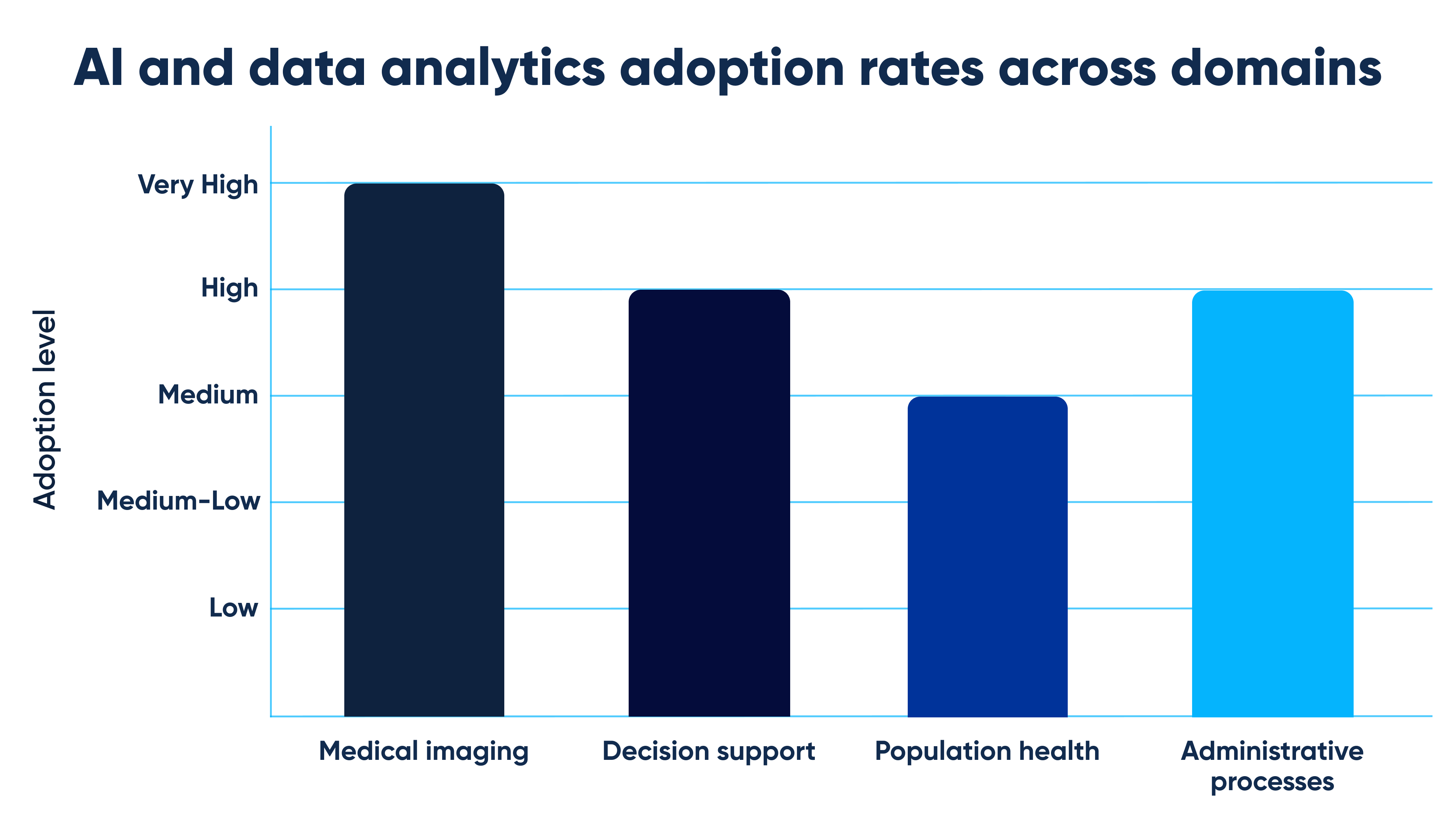
The adoption is different across domains:
- Medical imaging – highest amongst selected sectors
- Decision support – high-value area, with reports clearly showing significant improvement
- Population health – medium rates, but showing great value
- Administrative processes – high-value area, with reports explicitly emphasizing:
- Increased accuracy
- Reduced time and cost, which translate into direct, system-wide savings
- Optimized staffing
- Less overtime
Medical imaging
AI-based systems are showing superior ability in analyzing medical images, often exceeding human capabilities. More specifically, they’ve proven high accuracy in detecting breast cancer, cardiac dysfunction, neuro disorders (for example, Alzheimer’s disease), and common ophthalmological conditions.
Decision support
AI-backed systems also present outlier accuracy in predicting adverse events, thus allowing proactive intrusion. Most prominent, they’re proven great outcomes in fighting infection incidence through early risk recognition.
Population health
Moving further, intelligent analysis has demonstrated remarkable capabilities in anticipating healthcare trends. Recent research has highlighted that implementing artificial intelligence for predicting disease outbreaks (proven during and post-pandemic COVID-19 times) can detect early trends and guide resource allocation.
Administrative routines
Beyond bedside, intelligent analysis also optimizes administrative processes that consume major resources. Promising results were seen within automated document management, medical coding, scheduling, staffing, and overall everyday efficiency.
AI and healthcare innovation: clinical trials
Let’s look at another great example of matching clinical studies to patients.
That might be applied across domains to match clinical trials in oncology, infectious diseases, genetic disorders, and others.
Clinical trials are resource-intensive, as clinicians must review patient records, eligibility criteria, and databases. This includes conducting interviews, cross-checking systems, thoroughly verifying inclusion/exclusion criteria, and coordinating with departments and representatives, which typically takes weeks that patients don’t have.
The result: delayed enrollment, a high administrative burden, and potentially missed opportunities.
Clinical trials thus present a highly suitable domain for patient data analysis to automate routine processes. The initial patient registration, search, retrieval, eligibility screening and matching, and further patient support – all suitable for automation.
This way, the filtering is handled without draining clinical resources, while decisions are left to professionals.
AI-driven analytics pushing limits: key benefits
Is it really worth to commit when given the complexities that come with integration?
Optimized resources
Healthcare systems often face serious issues with capacity, equipment, staffing, and budgets going overboard. Intelligent analytics can predict patient surges with accuracy, spot bottlenecks before escalation, trigger alerts, and suggest the spots to allocate the resources.
That translates into less wasted resources (time, cost, human labor, and others) and overall higher efficiency.
Decision support
Healthcare experts are under constant pressure to make life-or-death decisions, and that as quickly as possible. Advanced analytics can process multiple sources – medical history and symptoms, imaging scans, lab results – and provide evidence-backed recommendations.
Let machines do the routine paperwork, so experts can focus on patients.
Personalized approaches
One size doesn’t fit all patients – AI technology can dive into symptoms, genetics, lifestyle, and demographic. From correct drug prescriptions to tailored physical therapy, the approaches are adapted, not predefined.
The result: less error, better care.
Data-backed research
Medical research moves fast, data though moves faster – AI algorithms can move in hours, not days or weeks. By identifying hidden correlations, predicting responses, simulating outcomes, and monitoring patient results, it transforms critical research (for example, drug discovery, physical therapy and rehabilitation, and more).
The payoff is remarkable.
AI-driven analytics taken seriously: the challenges of integration
Healthcare leaders are ready for innovation, but the path might be rocky.
Data privacy and security
Patient information is sensitive, and official regulatory bodies (HIPAA, GDPR) are setting stringent standards. Unauthorized access, data leaks, cross-border vulnerabilities, insider threats, and other security accidents might cause serious problems.
Data bias
Artificial intelligence is trained on public datasets collected across sources, which aren’t always representative. This means, a model can fail and bake existing inequities into workflows.
Successful integration with other healthcare systems
Proprietary formats, and messy, nonstandard documentation mean that most projects will stumble on cleaning. Now add clunky design and get hard-to-use tools that clinicians will avoid.
Ethical considerations
Opaque algorithms, vague liability, and concern about replacing the expert are causing ethical disturbances. Without explainability and elaborate governance frameworks the adoption will stall.
Real-world examples of integrating AI analytics
Predictive analytics to optimize operational capacity
Research Gate has found that hospitals are leveraging predictive analytics to anticipate operational demand: patient admission, staffing requirements, intensive care unit overflow, and other resource-related metrics. Their studies have shown that providers are allocating beds accordingly and schedule personnel efficiently.
Studies report measurable improvements in overall resource utilization and shorter average lengths of stay.
Advanced analytics for early sepsis detection
Carle Health have reshaped sepsis detection by combining advanced analytics and assisted clinical workflows. They cut the overall sepsis mortality by 22%.
These changes also allowed the staff to monitor individual performance and identify hidden bottlenecks.
ROI expectations: why implement AI analytics
The reason data intelligence is valuable goes beyond everyday automation – it is all about resource allocation. By transforming data sources into decisions, a provider can make better use of infrastructure and personnel.
ROI comes from several important changes:
- Less cost on staffing, beds, equipment, and other operational needs
- More time on patients
- Demand-based allocation of resources
- Data-driven decisions without guessing
- Higher efficiency through automation
- Better outcomes (for example, by identifying high-risk patients and intervening before escalation)
How we can help
Advanced analytics can turn data chaos into insights – but only with the right hands to manage the project. Without expertise, the smartest algorithms become just another expensive experiment to gather the dust.
Feasible progress will come from partners who get the modern healthcare industry and engineering like ours.
Our expertise:
Our services:
FAQ
Many mature healthcare organizations do use artificial intelligence for analytics, but with important caveats. Rather large healthcare systems commonly implement predictive models, decision support, and automation and smaller health systems are naturally less likely to commit.
In brief, the adoption is widespread among leaders but uneven across types of organizations and scenarios.
In some simple tasks, artificial intelligence can be as accurate (or better) than conventional manual processing. But that superb level of accuracy is not guaranteed across the board: data quality and clarity, data validation, and other common factors sensibly impact the performance.
The strategy to follow: always treat the outputs you get as suggestions, not the single point of truth.
In short, the stack and practice that turns those huge healthcare records into reliable, actionable intelligence. In practice, it’s robust data ingestion and cleaning, AI/ML & NLP models, data privacy, responsible governance.
So yes, AI/ML for Big Data healthcare analytics is a big trend, but requires proper planning.
There are mature patterns: RPA automation, entire pipelines that build validated models, and orchestration. Completely autonomous, self-directed algorithms that overtake complex decision-making without supervision are nascent and promising yet still quite risky.
To learn about how agentic systems can help healthcare providers, you can read our recent overviews:



 CLUTCH