AI-based pose detection for physical rehabilitation software
for MSK rehab
AI pose detection in digital physical therapy
While the COVID-19 crisis, telehealth adoption has grown from 1% to 80% in highly affected territories – ASPE. During the pandemic, patients switched from offline physical therapy visits to online telehealth solutions.
The digital-physical therapist platform takes this to the next level by using AI-based human motion capture to monitor exercises in real-time.
Physical therapy can improve MSK (musculoskeletal) outcomes but used to only be available in person. Earlier, human movement analysis required markers or sensors placed on the participant, expensive cameras, and trained personnel to assist. Not anymore.
The current developments of built-in cameras (tablets, smartphones) and AI-based pose detectors made it possible to track human motion with high accuracy and in real-time, with markerless motion capture, anywhere.
The business value of telerehabilitation software:
150% ROI
5 hours
saved by therapists per week
27%
faster patients recovery
1.6
times more patients
MSK screening with AI
Abto Software delivers the technology for real-time markerless motion capture that ensures skeleton tracking and high-quality human motion recognition that can be applied for a wide range of movements and exercises using just cameras of mobile devices or PC.
AI pose detection, specifically built to facilitate a smooth integration of MSK rehab platforms to empower personal physical therapists.
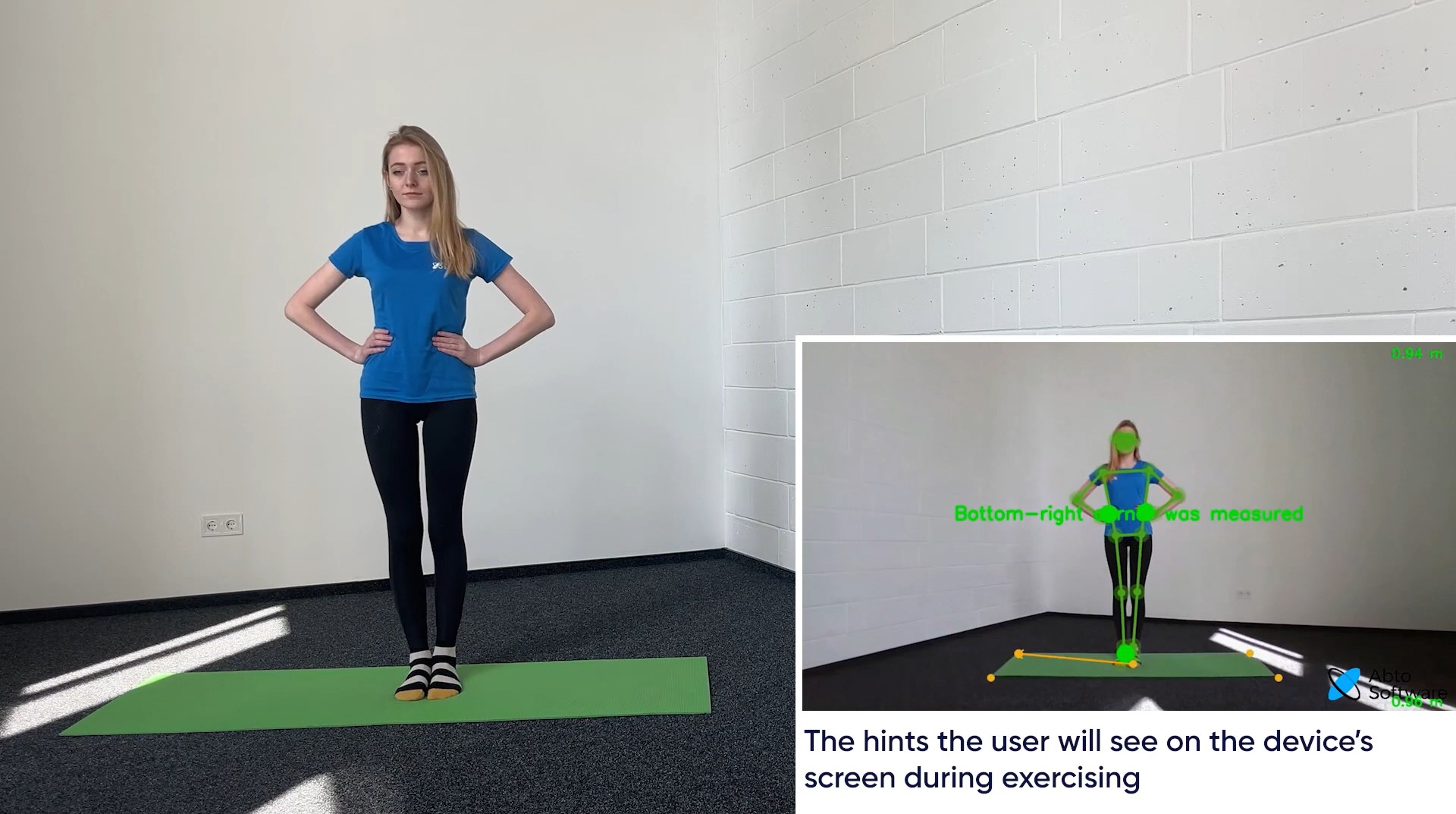
Our technology is meant to transform virtual physical therapy care by using a live video stream, from a mobile or PC camera and advanced AI motion tracking techniques to replace bulky sensors and accurately perform complex analyses to empower physical therapists. No additional hardware or software is required.
Backed by years of experience, our engineers built a custom real-time AI-based human body motion analysis technology for MSK rehabilitation therapy.

Steps for utilizing AI-powered markerless pose detection in rehab software

1. Make sure to have no other people in the background
2. Wear contrasting clothes when exercising in front of the camera to avoid blending with the background
3. Use a mat or tourist pad contrast to your floor to determine the dimensions
4. The user should start the exercise after voice instruction
Benefits of pose estimation technology for MSK rehabilitation
Using pose detection technology in telerehabilitation, established businesses can achieve:

Business growth
AI-based digital therapeutics, markerless motion capture in particular, allow to automate of therapists’ routine work and can service 1.6 times more patients, multiplying the clinic’s capacity.
Staying ahead of the competition in the MSK rehabilitation market
Digital MSK care is booming, and there is a risk of losing business if not adapting to new demands. Global digital health market for musculoskeletal conditions to hit USD 20.5bn by 2026, with CAGR of 18.2% – Fortune Business Insights.
Own technology
The development of its own custom camera-based motion detection software for MSK rehab takes time, but with the right IT partner, it’s minimized. With us, the customer gets all benefits of keeping IP: the unlimited possibility to scale it for different exercises and avoid paying any usage fees.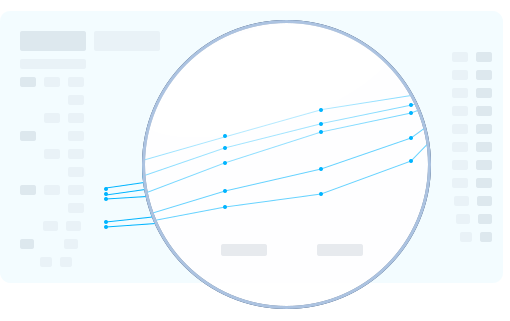
Value for physical therapists and medical workers:
- Time-saving – the therapist has no need to attend every patient training
- Automatic data collection & analysis – all patient data is stored, structured, analyzed and visualized on the online dashboards
- Data-driven care – using precise motion detection data from MSK screening means more accurate prescriptions and recovery/treatment plans
- Custom-configured alerts – can be set up to automatically notify you of important events, such as a patient missing two training sessions in a row or a dramatic decrease in performance
For MSK patients, AI pose estimation technology offers:
- No hardware or sensors – a smartphone or laptop with a camera is your only tool for accurate measurement of the accuracy and progress
- Flexibility in exercise timing – exercise anytime without the need to synchronize your time with the therapist
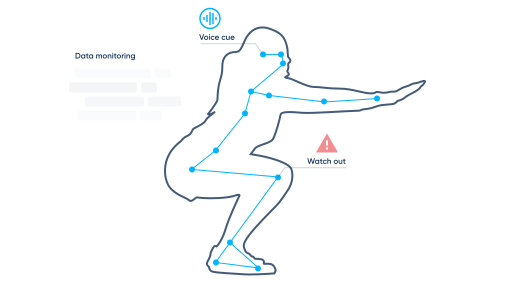
- Precise video guidance – real-time human motion recognition & guidance during MSK therapy exercising identifies errors and leads patients with audio and video cues
- Progress tracking and visualization – performance data dashboards allow you and your therapist to compare stats from recent sessions and previous weeks or months
- Storage and access to recorded training videos
Our sensorless tech detects movement and gives real-time feedback sans clinician support.
- 32 joints monitored
- Hardware independent
- Markerless
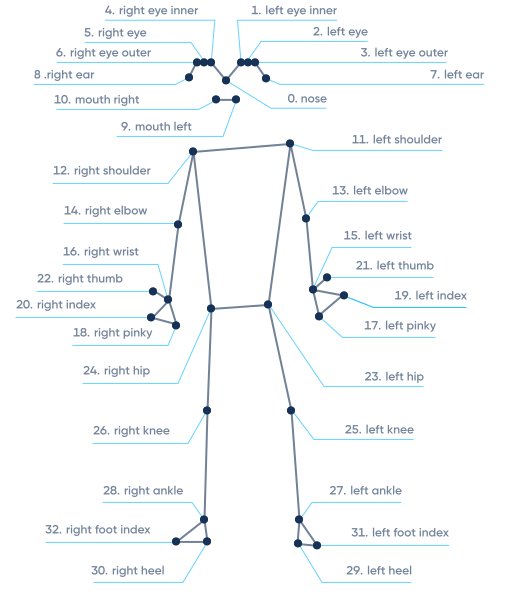
Human pose estimation and analysis software:
- Has no usage fee
- Runs on iOS, Android, edge devices, and high-load servers – compatible with smartphones, tablets, and computers
- Provides extended key points skeletons
- Works without markers or sensors
- Shows custom analysis for single and multiple persons
- Supports a wide range of different movements/exercises
- Provides motion detection & tracking in real-time
- HIPAA-compliant, FDA
- Shows high accuracy: different accuracy metrics can be supported
Areas of use
We develop the next generation of affordable markerless motion capture for integrated care for MSK patients aimed at improving clinical outcomes and shortening recovery times.
Computer vision technology that provides accurate skeleton measurements in real-time can be used in:
- Clinical assessment
- Sport performance
- Animation
In Healthtech, real-time motion analysis software can improve:
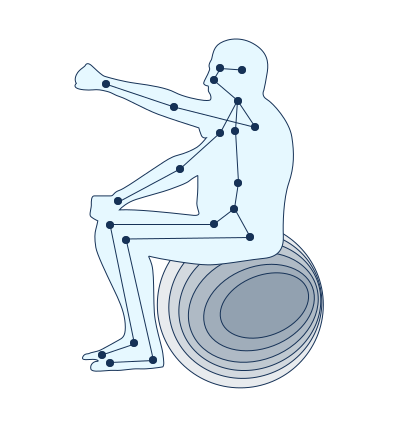
- Digital therapeutics
- Digital rehabilitation
- Elderly care/geriatric physical therapy
- Orthopedics and sports medicine
- Prosthetic design and fitting
- Surgical planning
- Spinal rehab
CV-based movement analysis software benefits:
- Patients undergoing physical therapy for rehabilitation
- Patients with chronic conditions
- Elderly people at risk of falls
- Disabled people
- Medical professionals and geriatric physical therapists
Empower your digital physical therapy platform with camera-based motion analysis technology
As a part of the telerehabilitation platform, physical rehabilitation computer vision assessment can:

Empower the physical therapist
The physical therapy AI platform stores, digitalizes and visualizes the execution of the exercises in real-time. Users’ movements are tracked and rated while receiving tips on how to speed up recovery and reach health and wellness goals.
By working out in front of the phone camera, patients can receive real-time feedback on movements and prevent injuries.
Afterward, the patient and physical therapist can review all results offline and see the progress for the target period.

Release the physical therapist from the most routine and time-consuming tasks
The AI physical therapy platform provides real-time guidance and motivation for patients during exercise execution via voice and visualization on-screen.
The physical therapist receives a notification once the exercises are completed, and results are available for review and approval.
Such an approach increases the number of patients one physical therapist can service on daily basis. Also, using data-driven solutions MSK screening optimizes physical therapy outcomes, resulting in more efficient patient management and shorter recovery times.

Early MSK problems detection
With automatic skeletal recognition, accurate and instant analysis allows proactive detection of musculoskeletal problems, risks, and various pathologies, enabling timely treatment and prevention.
This way, human body motion analysis, powered by AL and ML allows for assessing, predicting, preventing, and managing MSK injuries.
Will AI replace physical therapists?
The answer is no. Research shows that the patient-doctor relationship is crucial and influences the entire treatment experience and cannot be eliminated e.g. AI brings MSK benefits like more accurate results and faster rehabilitation.
As stated by NCBI in their cross-sectional study about physical therapists’ attitude toward using AI:
- 72,8% of surveyed participants agreed that PT AI significantly minimized the workload of therapists
- 82,7% agreed that AI can facilitate patient care
- 53,9% agreed that AI can help prevent disease
We at Abto Software can assure you that AI (and AI-based markerless motion capture) isn’t going to replace but will positively complement in-person services, providing enhanced patient outcomes.
Opportunities
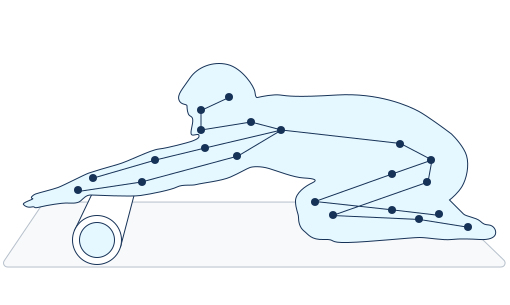
Depending on your business needs, our human pose estimation technology can be expanded with the following functionality.
- Adding age and gender normative analysis
- Automatic day-to-day progress comparison
- ML-generated exercises’ recommendation, e.g. actionable plans to improve joints’ functional status
- Asymmetries collecting with visual alerts
- Skeleton graph and measurement
Let us help you building your physical rehabilitation software!
FAQ
Human pose estimation uses computer vision to detect and track body movement from standard camera feeds – no markers, no sensors.
The system:
- Captures a video stream (laptop, tablet, or smartphone)
- Detects the person standing in frame
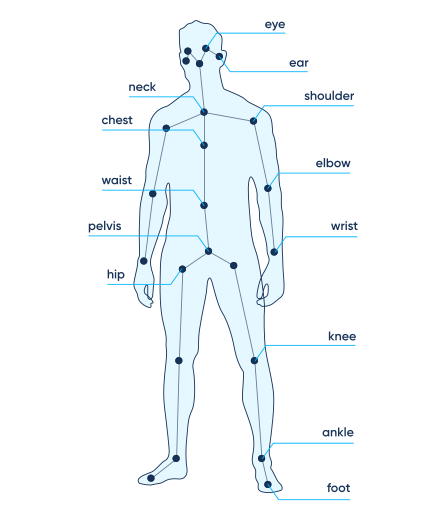
- Identifies the anatomical landmarks (or keypoints): shoulders, elbows, hips, knees, and more
- Creates a skeletal model
- Calculates the joint angles, motion range, movement quality, and symmetry
- Compares the obtained results against protocols
2D models:
- Can track body keypoints on an X-Y plane
- Only uses a single RGB camera
- Is suitable for basic movement tracking
- Has lower computational costs
3D models:
- Can track X-Y-Z coordinates (adds depth)
- Can use multi-camera setups
- Is better for complex application scenarios
- Can power more precise biomechanical analysis
Pose estimation is nowadays widely adopted across industries that rely on accurate motion analysis.
These include;
- Healthcare technology: physical therapy & rehabilitation, all remote
- Sports & fitness tech: performance tracking, injury prevention, and more
- Gaming & AR/VR products: immersive interaction
- Ergonomics & workplace safety: posture monitoring
Pose estimation is using anatomical landmarks, also known as keypoints – shoulders, elbows, hips, knees – which enables to recognize motion accurately.
By measuring the change in position and movement between keypoints, the algorithm can calculate:
- Joint angles
- Motion range
- Movement quality
- Overall symmetry, and more
With efficient neural networks, GPU or edge acceleration, pose detection can process video streams at about 20-60 frames per second.
That enables:
- Live sessions
- Repetition counting
- Form correction
- Instant feedback
Properly designed, pose detection can comply with strict data standards (HIPAA, GDPR, HL7, FHIR, and more).
Such systems:
- Extract the skeletal keypoints without storing raw video
- Process the data locally (edge computing)
- Don’t use facial recognition
- Encrypt before data transmission
Contact us



 CLUTCH