AI agents for smarter hospital workflows

AI agents, with generative AI capabilities and advanced predictive models, are automating hospital workflows. Standardized workflows, data-driven decisions, operational efficiency, resource optimization and management – AI agents are migrating from laboratories into actual hospital settings.
Early rollouts are showing 6% reduction in length of stay and almost clinical accuracy (89% high) in triage.
Artificial intelligence is transforming large industries, and today’s healthcare technology is also under impact. Healthcare executives are beginning to implement entire layers into workflows that touch patient admission, diagnosis, treatment, and monitoring, not just niche assistants.
And, whether you’re ready or not, AI agents are going to penetrate hospital workflows and change the game.
What are AI agents?
AI agents are models that sense their environment, make decisions, and act upon achieving specific objectives. They range from simple rule-based implementations to advanced, ever-evolving systems that leverage a range of disciplines – predictive analytics, reinforcement learning, and natural language processing.
AI agents in the healthcare segment are moving from laboratories to hospitals, where they empower clinicians. They handle the routines from triage to discharge – diagnostics, treatment, patient monitoring, clinical studies – a tool freeing specialists to focus on priorities.
The types of hospital AI agents
Full-pledged agent-specific adoption figures are still quite limited, but the building blocks are already in place: the uptake in usage of predictive AI solutions is large and growing – a trend that indicates overall readiness. The fact of interest in predictive AI capabilities is the basis needed to make a prediction for the coming years.
Here are some up-to-date adoption findings worth considering:
- Administrative automation is showing the biggest adoption rates:
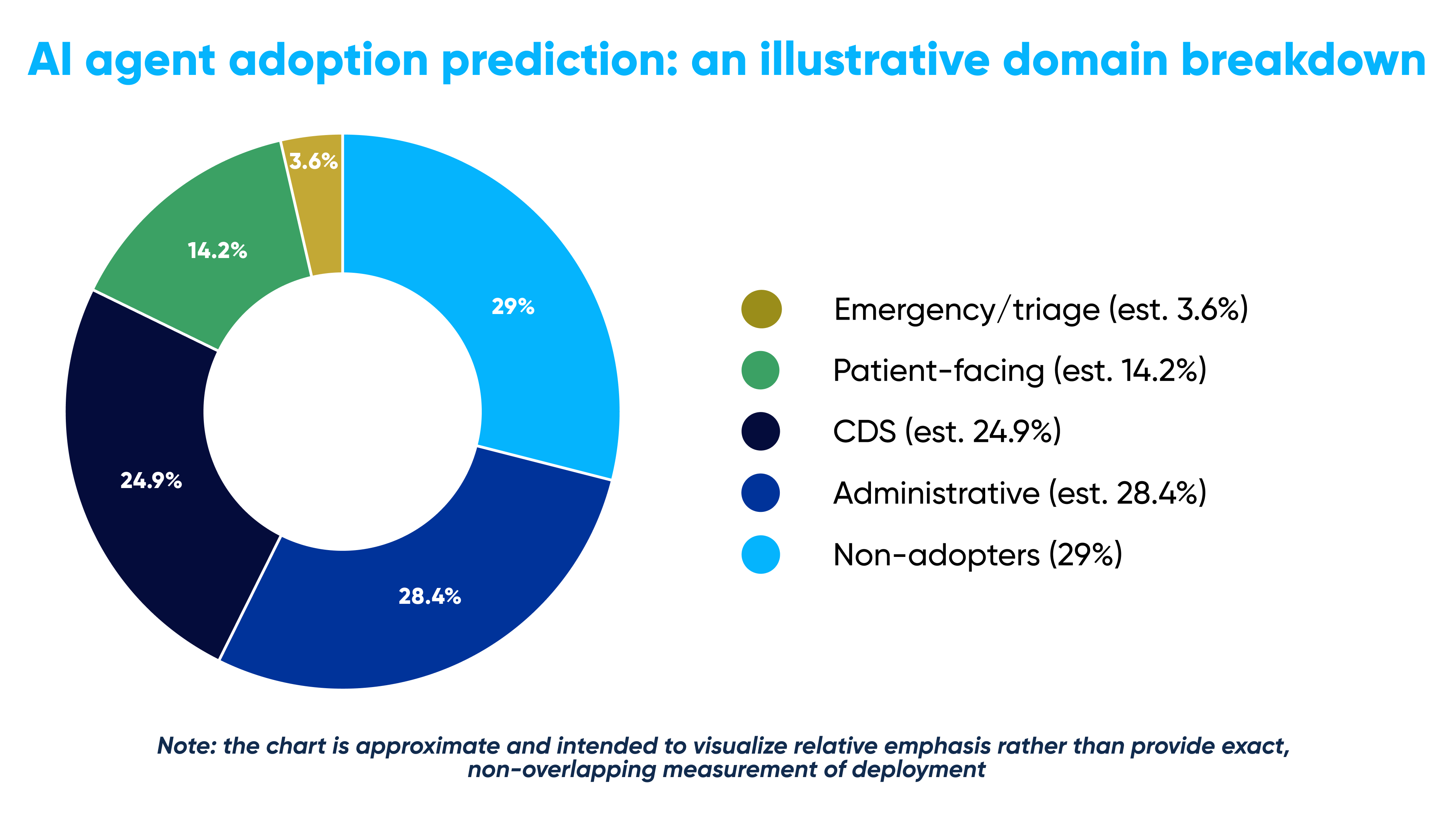
- 61% of healthcare providers are automating billing processes
- 67% of healthcare facilities are reshaping scheduling routines to minimize manual labor
- Clinical decision-making: 71% of hospitals reported the utilization of predictive AI tools
- Patient care, virtual nursing, and monitoring are mixed but growing from pilots to production:
- 10% report virtual care has become a standard, organization-wide capability
- 46% report virtual care are either still piloting or used for automated inpatient programs
- When talking emergency response, there aren’t any reliable, official statistics for adoption in hospitals, but there’s enough evidence about related AI uptake and performance for making some predictions – in particular, up to 10% of hospitals run AI tools (as pilots) to support emergency departments
Even though full multi-agent rollouts remain a touch too early, AI agent deployments emerge with speed.
Put together, we dared to make a forecast, but treat the numbers we suggest as estimates, not promises:
Administrative agents: more efficiency, less overhead
These agents can automate daily tasks (scheduling, billing, and others) to minimize manual burden and delays. They extract key insights from documents and orchestrate the workflows to optimize operational time and cost and free the staff for higher value tasks.
Clinical decision support agents: evidence-based recommendations
These agents can analyze patient records, labs, imaging, and guidelines to empower insight-backed decisions. They integrate with other medical systems and utilize predictive models to surface the most relevant evidence and provide the insights clinicians need to ensure high-level accuracy.
Patient care AI agents: bedside support
Medication reminders, remote-monitoring assistants, conversational bots, and autonomous virtual “nurses”. They personalize patient experiences and education (for example, by tracking medication intake and response) to ensure positive dynamics and outcomes.
Emergency response AI agents: critical decision-making
Emergency prioritization, resource-allocation assistance, and analytics during mass-casualties and epidemics. They synthesize historical patterns, sensor feeds, and other key records to ensure teams respond without delay and place scarce resources where needed.
The benefits of using AI agents for automation in hospitals
Recent pilots and figures are showing hospital-level benefits:
- Agent-style tools that forecast bed needs and discharge have shown measurable results: one rollout has reported an over 6% reduction in length of stay and a measurable drop in readmissions
- Multi-agent triage can reach near-clinical accuracy: 89.2% accuracy after iterative agent interaction
Let’s discuss some opportunities in detail:
Standardized workflows
An agent can enforce consistent execution of processes across departments, both administrative and clinical. This means less variability – data entry, triage, documentation, and reporting remain consistent and accurate.
This eliminates human error, improves visibility, enhances compliance, and ensures audit readiness.
Data-driven decision-making
An agent can transform fragmented records into impactful real-time insights to support healthcare automation. The continuous data analysis might empower better judgement over staffing, care pathways, equipment use, and other daily matters.
For executives, this means strategic planning and measurable ROI through evidence-backed decisions.
Operational efficiency
AI agents can help with routines – from scheduling and billing to documentation – thus freeing the specialists. This reduces operational bottlenecks and increases patient throughput without requiring greater headcount.
Resource optimization
AI agents can forecast patient volumes, personnel demand, supply needs, and even equipment maintenance. This enables predictive management and prevents potential overstaffing or shortages – a benefit to hospitals who experience excessive spending.
The challenges of using AI agents for automation in hospitals
AI adoption is carrying real-world consequences: lacking validation and evidence, regulatory non-compliance, and other serious flaws do not just affect KPIs alone – they affect whether patients are getting appropriate care. AI trust isn’t built on accuracy as the critical figure; it’s earned through transparency, responsible governance, and accountability.
Let’s discuss important challenges to consider before implementation:
Clinical validation & evidence
The models that perform as expected in development often underperform in uncontrolled, real-world settings. The issues might include a gap between workflows, dataset differences, limited testing, and other, not always predictable limitations.
Mitigation measures might include:
- Prospective pilots
- Independent evaluation
- Subgroup reporting
- Real-time monitoring
Regulatory approval & certification
The rules for integrating medical software & hardware, as well as algorithms are changing quite dynamically. Different jurisdictions (for example, FDA versus EU administrations) are applying different models on risks, which complicates multi-market expansion in perspective.
Mitigation measures might include:
- Regulatory analysis
- Change-control notices
- Premarket evidence or equivalence
- Post-market reporting
Legal liability
If models suddenly cause any harm, the responsibility might implicate the vendor, the integrator, and others. The existing case law and guidance are tending to place ultimate responsibility with providers, but contracts are shaping risk exposure.
Mitigation measures might include:
- Contractual indemnities
- Clinical policies
- Decision logging
- Indemnity & insurance review
Data quality & representativeness
Biased, incomplete, or unrepresentative data produces an inequity for specific social groups and conditions. Domain and concept drift further deteriorate the performance after deployment.
Mitigation measures might include:
- Domain-shift monitoring
- Performance reports
- Re-training plans
- Local calibration
AI agents in hospitals: real-world applications
AI agents for healthcare are no longer another bold experiment – they’re proving practical value across workflows in hospitals. But still, successful adoption heavily depends on integration, data quality and representativeness, and careful, responsible government.
AI agents in healthcare – correctly implemented of course – are proving to bring real results:
AI agents: an extensive, systematic review
A study that reviewed 18 papers on applying multi-agent systems:
- Has highlighted higher accuracy in diagnostics, better coordination, and support throughout treatment
- But flagged data interoperability and bias, as well as widespread ethical concerns
- Key insights: AI agents are proving their value across several healthcare workflows while raising some concerns, which means that safe, controlled application might require AI expertise.
AI agents for simulating healthcare scenarios
More focused on education, this study broadly explores the usage of agents for crafting healthcare scenarios. More specifically, it unravels how agents can automate objective generation, patient narratives, and debriefing, all scenarios the design of which typically requires significant resources.
Key insights: in education, AI agents are poised to transform applicable training by creating real-world scenarios (once again, when built and integrated by teams who know healthcare specifics).
A multi-agent, dynamic approach to triage
One paper has presented a system with three specialist agents that collaborated on triage and demonstrated:
- 89.2 % accuracy in primary department classification
- 73.9 % accuracy in secondary department classification
Key insights: multi-agent systems are reaching near-clinical accuracy, thus showing how introducing AI agents can streamline patient routing.
A network for decision-support in radiology
A paper has presented an analysis of multiple specialist agents entirely dedicated to processes within radiology. By taking over scheduling, data preprocessing, pattern extraction, and follow-ups, the agents sensibly simplified the department’s day-by-day workflows, in particular by automating routine work.
Key insights: multi-agent systems can automate diverse workflows, thereby empowering stressed radiologists.
AI agents in hospitals: now’s the right time
The adoption is uneven, the validation in process, and experts are warning against overreliance on technology. Rapid rollouts are raising governance questions: who’s accountable for doctor-agent generated suggestions, how will regulators certify such systems, will rural hospitals gain equal access?
But despite the concerns, one thing is certain: the changes are inevitable.
AI agents aren’t just a quickly passing novelty – they’re coming to stay and become the plumbing of hospitals. Clinical decisions, administrative workflows, patient care, emergency response, and other complex processes – AI agents are escaping the lab.
Strategic providers will stitch agent systems into workflows right away and leverage the benefits they deliver. The rest will follow, not because agent systems are efficient but because they cover the routines that restrain medical specialists from focusing on priorities.
How we can help
AI agents are poised to transform healthcare operations across hospitals by automating everyday workflows. Those mastering clinical validation, regulatory compliance, legal liability, and associated data quality & safety, are going to unlock big prospects.
From forms to purpose: stop losing work hours on paperwork – let’s shift the routines to specialist AI agents.
Our expertise:
- AI solutions engineering services
- AI for digital physiotherapy
- Robotic process automation services
- Hyperautomation services
Our services:






 CLUTCH