


AI agents for business automation success

AI agents aren’t a futuristic concept – they reshape how companies are managing and scaling their operations. Unlike rule-based task automation, these systems can manage complex workflows, thus unlocking new abilities that were once out of reach.
74% of business leaders report seeing ROI from AI agents within the first year of deployment – among those, 39% have doubled productivity, which shows that rapid, measurable impact is achievable.
What are AI agents?
AI agents are systems that perceive their environment, interpret inputs, make decisions, and act towards goals. Clinical coordination, clinical trials, AML/KYC checks, loan underwriting, dynamic pricing, demand forecasting – an agent can handle all without human intervention.
The agents are autonomous and proactive, often capable of learning and adapting to environments over time. That makes them perfect to manage more complex, dynamic tasks and workflows.
IBM defines AI agents as systems that perform various tasks by creating entire flows by using available tools.
TechTarget frames AI agents as programs that can make decisions by navigating their environments, use input, and experiences they gained.
What are an agent’s key characteristics?
| Autonomy | An agent can work without constant human interaction: it charts the path and acts upon goals all on its own – whether resolving individual conflicts or orchestrating multiple subtasks |
| Proactivity | It doesn’t just react – it understands overarching goals and breaks them into executable plans in advance |
| Perception & interaction | An agent can “sense” its surroundings – whether through physical sensors or inputs – and interpret (for example, by using natural language processing algorithms) these insights to make further decisions |
| Reasoning & learning | It analyzes gathered insights by using LLMs or ML algorithms, updates workflows, adapts accordingly, and learns from its past actions |
The market in numbers
Key statistics:
- Some organizations uniformly predict the market to reach from only $5-7 to $50+ billion in 2025-2030
- Grand View Research forecasts the market will expand to over $50 billion by 2030
- The Research Insights report the market will grow to over $54 billion by 2030
- Other publications make less humble predictions ranging from $95 to $220 billion by 2032-2035
Key insights:
- All projections are pointing to 25-50x market growth over the next decade
- North America is dominating the market in share
- Enterprise spending is going toward agents rather than AI automation
- The demand for industry-specific AI applications is rising
The broader business impact
The agent is moving from another experimental pilot to changing how work gets managed across enterprises. Recent surveys and reports are showing rapid adoption, measurable benefits, and growing C-suite confidence in automation.
For example:
- As to PwC’s study, 66% of companies adopting specialist agents have reported increased productivity
- 57% noted cost savings
- 55% experience faster decision-making
- As to IBM’s report, 86% of executives believe that agents will transform business automation by 2027
Let’s unpack the terms “AI agent” and “automation”
Traditional automation in the broad sense
– the technology that minimizes or eliminates human intervention in tasks and processes across departments. It’s the overarching umbrella under which more specific tools reside.
And agents
– the technology that goes beyond following scripted logic, perceives context, reasons, decides, and evolves. It’s specialized, more complex, and requires thoughtful governance and planning for deployment and support.
The differences between autonomous AI agents vs automation
Traditional automation | AI agents | |
Scope | A term that covers many approaches (in particular, BPA, RPA, intelligent automation, and hyperautomation) | A class of automation that adds a layer of autonomy |
| Approach | Rules, scripts, PLCs, APIs, workflow engines, GUI automation: deterministic and pre-defined steps | LLMs and ML algorithms with tools and orchestration to select next actions and adapt |
| Autonomy | Varies widely, but many traditional automations (RPA especially) are low-autonomy and require human design/maintenance | High autonomy: an agent can set or pursue smaller goals and act within constraints |
| Adaptability | Brittle unless paired with ML algorithms | Specifically designed to adapt/learn from feedback or data |
| Inputs | Structured data, fixed formats, sensor telemetry (industrial automation) | Unstructured/mixed data (text, documents, knowledge bases) along with structured inputs |
| Applications | Repetitive tasks: data entry, rule-based approvals, scheduled tasks, machine control | Complex orchestration, document understanding, multi-step problem solving, proactive customer handling |
AI agent automation unraveled: the components
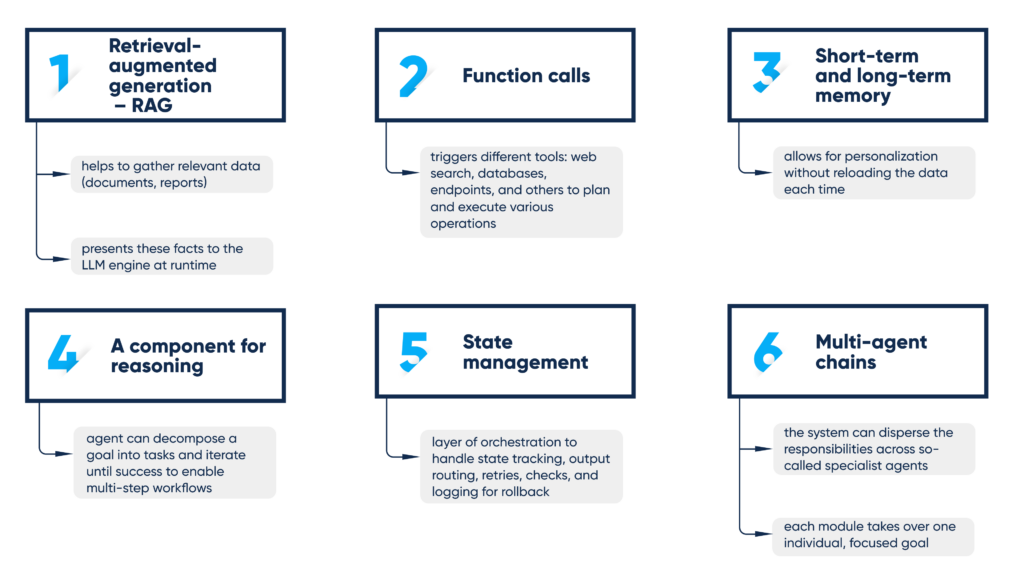
Retrieval-augmented generation – RAG grounding the model in facts
RAG helps to gather relevant data (documents, reports) and present these facts to the LLM engine at runtime. RAG allows to ground received responses and minimizes so-called hallucinations.
Function calls – from text to action
An agent isn’t just another chatbot – it triggers different tools: web search, databases, endpoints, and others. This way, the agent can plan and execute various operations, from opening a ticket to updating a spreadsheet, and more complex workflows.
Short-term and long-term memory
Good agents can maintain previous context and even long-term memory (for example, preferences, decisions). That allows for personalization without reloading the data each time.
A component for reasoning
Rather than just answering the prompts, an agent can decompose a goal into tasks and iterate until success. That enables multi-step workflows – for example, from finding latest reports to emailing involved managers.
State management
The layer of orchestration will handle state tracking, output routing, retries, checks, and logging for rollback. That allows robust behavior, a must for enterprises.
Multi-agent chains to divide and conquer
For more complex workflows, the system can disperse the responsibilities across so-called specialist agents. This enables greater reliability and throughput by letting each module take over one individual, focused goal.
AI agent automation systems by function
Assistant agents
– reactive helpers that execute explicit requests (scheduling meetings, drafting emails, and similar).
- Business value: less time spent doing routine activities, more time for focused, creative work
- For example: a scheduler that books meeting slots and creates calendar events and reminders
Agentic agents
– goal-driven executors that set and pursue specific objectives with minimal human direction and control.
- Business value: fully automated end-to-end workflows that don’t require intervention
- For example: a system that identifies overdue invoices and updates financial reports
Specialist agents
– expert helpers that handle specific functions (legal review, financial reporting, and others).
- Business benefit: near-expert throughput on tasks while preserving human oversight
- For example: contract-review agent that highlights risky clauses and drafts according revisions
Coordinator agents
– smart managers that control other agents and tools.
- Business value: an automation of retries, fallbacks, hand-offs, and other auditable processes
- For example: an agent that runs monthly reports, triggers scripts, complies results, and more
Monitoring agents
– alerting agents that watch business operations and can either act or escalate.
- Business value: SLA & MTTR improvement, proactive remediation
- For example: an agent that detects degraded services for diagnostics and ticketing
Recommendation agents
– support agents that collect relevant information and suggest next actions for employees or automations.
- Business benefit: a speed-up of decisions
- For example: an agent that ranks lead quality and suggests outreach scripts
The best AI agents out there
Pick agents that match your stack and appetite:
- some tools are plug-and-play
- others rather advanced toolkits for bespoke, mission-critical automation
Microsoft Copilot
- Power Automate
- Copilot Studio
Best option for enterprises already using Microsoft 365 who want native automation for their MS applications (Outlook, teams, SharePoint, Office).
Key highlights:
- A natural-language flow creation
- A cloud flow builder
- And “computer-use” style capabilities to interact with websites and applications when no API exists
Automation Anywhere
- IQ Bot
- Automation Cloud
Best option for organizations with heavy document processing (invoices, forms, and more).
Key highlights: a cognitive document ingestion that minimizes exception handling.
UiPath
- Agent Builder
- Agentic Automation
Best option for large back-office/shared-services/finance teams that need their enterprise RPA augmented.
Key highlights:
- An enterprise-grade agent builder that ties LLM decisioning into existing RPA workflows
- Agentic orchestration (Maestro tool)
- And connectors for complex process automation
Zapier
- Classic Zaps
- Agentic tooling
Best option for small and medium non-technical teams that need fast automations across applications.
Key highlights:
- No-code creation
- Deep catalog of over 8,000 integrations
- And simple “teach an agent” flows
OpenAI
GPTs & function calling
Best option for teams that want conversational agents and automation for internal, everyday workflows (research assistants, helpdesk, operations, and others).
Key highlights:
- GPTs without heavy engineering
- Built-in function-calling and plugins to connect to systems
- Control access (enterprise features)
Workato
Genie & agentic orchestration
Best option for teams that require iPaaS integrations with advanced agent orchestration.
Key highlights: agentic orchestration built upon a mature iPaaS platform that connects many applications.
LangChain & LangSmith
Agent frameworks & infrastructure
Best option for teams that build bespoke agents for features, long-running workflows, and analytics.
Key highlights:
- Mature framework
- Tool/chain primitives
- Deployment infrastructure for testing, memory, scaling, and long-running agent workloads
Auto-GPT, AgentGPT, BabyAGI
Agent projects
Best option for teams (and prototypes) who want to experiment with autonomous multi-step agents.
Key highlights: open-source autonomous agent patterns that plan, split tasks and call other tools.
Some important tips before you implement AI agents
1. Choose focused, measurable pilots
Choose repetitive, rule-driven tasks that are painful enough to automate and justify business transformation. Invoice triage, lead qualification, support tickets, or reporting, for example.
2. Audit early
Map permissions, security policies, and tools the agents will access before unfolding software development. Most delays happen because integration dependencies are discovered too late.
3. Match approach to your team’s capabilities
No-code and low-code platforms work well for operations, human resources, marketing teams, and similar. Talking about product features, rather complex business logic, or orchestration, developer platforms are better.
4. Build guardrails from start
Introduce human-in-the-loop for critical business decisions, limit permissions, and define escalation paths. Protect workflows and brand.
The benefits of using AI agents for automation
AI agents are tireless digital collaborators – self-programming, learning, making decisions, adapting on-the-fly. They maintain pulled context across tasks and perform required actions.
In practice, this means these systems can plan multi-step processes and execute them without human supervision.
Elastic scalability
AI agent, being digital, can expand when there’s higher load and taper when loads are lower without direction. This provides a level of availability that’s impossible with fixed human schedules, without hiring and layoffs.
Built-in resilience
An agent vigilantly monitors for disruptions and correct detected issues before they can cascade into failures. For example, in logistics, the system can switch the supplier or re-route a shipment when detecting a delay, thereby keeping supply chains running smoothly.
Goal-driven action
They can proactively operate toward specified business goals unlike other passive tools you have surely seen. For example, in construction, an agent can suggest relevant optimizations and initiate new actions if needed, which drives business agility.
Previously unavailable business models
They can, when embedded into products and services, also unlock revenue streams and attract more clients. For example, in machinery, an agent might introduce additional features and trigger non-planned maintenance, thereby enabling either pay-per-use or subscriptions previously infeasible.
The pitfalls of using AI agents for automation
AI agents might promise great profits, but enterprises routinely experience technical issues during production. At scale, the architecture, data plumbing, and other project stages often overwhelm unprepared engineers.
In short, they are not just plug-and-play solutions, but done by the right team, they might boost operations.
Correct integration
Legacy systems typically don’t have standardized data formats, and integration might thus require middleware. This complexity gets engineers often stuck within preparation.
Navigating orchestration
Packed with multi-step workflows, some pilots might devolve into messy “glue code” and require extra work. Such systems may work in prototype but crumble in production.
Data quality & governance
Many teams don’t notice data incompleteness and inconsistency soon enough, which screws overall accuracy. This problem requires measures that include strong pipelines, validation checks, and governance, which require domain expertise.
Data safety & oversight
Nearly every second company has reported negative incidents associated with out-of-policy outputs and bias. That means that inaccuracies are appearing frequently enough that oversight can’t be an afterthought.
How we can help
AI agents can handle more than mouse clicks – they provide a smart digital workforce that learns and adapts. By embedding these into critical operations, business leaders can reinvent everyday workflows, thus gaining superb speed, flexibility, scalability, and new revenue paths.
Contact us to build an always-on, strategic asset.
Our expertise:
Our services:
Contact us to discuss your tailored AI agent for automation – we turn ambitious ideas into reality.
All insights are drawn from leading industry companies and studies that highlight the general business impact.
FAQ
AI agents are systems that perceive their environment, interpret context, make decisions, and act upon goals. They plan multi-step workflows, can interact with tools, browse sources, monitor activities, as well as evolve.
These capabilities are part of the broader shift toward adopting agentic AI for business process automation.
AI agents are systems that have contextual understanding, can execute entire sequences, and adapt to change. They don’t just follow fixed rules.
They implement the ideas or rather the principles standing behind agentic AI.
The risks include hallucinations (incorrect outputs), unintended actions, data breaches, and non-compliance. The deployment requires measures including monitoring, human-in-the-loop checkpoints, defined boundaries, and explainability, or, generalized, – specialized expertise.
Yes, engineers do use them too to handle different tasks: code generation, testing, documentation, and others. This allows more focus on design, planning, problem-solving, and other high-value responsibilities.
It’s not about connecting LLM (large language models) – it’s about thought-out architecture & governance:
- Start with specific objectives
- Design agents around tools, not prompts
- Create clear decision boundaries
- Prioritize observability and control
- Secure your data from day one
- Test agents with real edge cases
You can also choose either prebuilt or configurable, but remember, these typically come with a nuance:
- Preconfigured workflows
- Built-in connectors to common business systems
- Guardrails and governance layers
- And industry-specific use cases



 CLUTCH