Legacy system modernization strategy: a step-by-step roadmap

- A legacy modernization roadmap is a phased plan that moves a critical system to a modern architecture while it keeps running. Each phase is tied to a measurable business outcome.
- Modernize now if your platform is nearing end of support, small changes take weeks, knowledge sits with a few people, teams work around the system, or run costs keep rising.
- Phased modernization beats a big-bang rewrite for complex systems because old and new run side by side until each part is proven. The trade-off is a longer timeline and a period of running two systems at once.
- The four phases are Assess, Design and prove, Migrate incrementally, and Decommission. Each one ends at a go/no-go gate.
- Cost depends on scope, integrations, data quality and the approach you choose. Compare vendors on total cost of ownership, not hourly rates.
- Results only last with governance: a recurring tech-debt budget, clear owners for every system, and metrics checked every quarter.
Your core software system still works. That is exactly the problem with most legacy systems. It works well enough that nobody wants to touch it, yet every new feature takes longer, every security audit finds something new, and the two engineers who truly understand it are getting harder to replace.
Legacy modernization is the obvious answer, but rebuilding the system from scratch feels like betting the business on a single release. The way out is not a bigger project. It is a better plan: a legacy modernization roadmap that breaks the change into phases, each one delivering value and each one reversible. The stakes are real. According to the U.S. Government Accountability Office (GAO), federal agencies typically spend about 80% of their IT budgets on operating and maintaining existing systems, including legacy ones. Private companies rarely publish the number, but anyone working with legacy systems would recognize the pattern: legacy systems cost more every year while business needs keep moving.
This guide to legacy system modernization walks you through what a modernization roadmap is, how to evaluate legacy systems, how to choose a legacy modernization approach, who should be on the team, what it costs, and a four-phase plan you can start this quarter.
What is a legacy modernization roadmap?
A legacy modernization roadmap is a time-boxed, phased plan that moves a business-critical system from its current technology to a target architecture while the system keeps running, with each phase tied to a measurable business outcome.
It answers four questions in order: what you have, what matters most, how each part will change, and when. Everything else in the legacy modernization process is detail.
Strategy, roadmap and plan: what’s the difference?
The terms get used interchangeably, but they sit at different altitudes. Your strategy sets the destination and the business goals behind it: lower run costs, faster releases, scalability, cloud readiness, compliance. The roadmap sequences the journey into phases and decision gates across months or years. The legacy modernization plan is the execution layer for the current phase: backlog, owners, budget, test approach and cutover dates. Teams that skip the middle layer tend to jump from a slide deck straight into code and discover every hidden dependency the hard way.
Phased modernization vs. the big-bang rewrite
A big-bang rewrite replaces the entire system in one release, usually by building a new system from the ground up. It looks clean on paper and fails in practice more often than it should, because the old system keeps changing while the new one is being built, and nothing is proven until launch day.
Phased modernization replaces a system piece by piece, with old and new running side by side until each part is proven. The best-known version is the strangler fig pattern described by Martin Fowler: a routing layer in front of the monolithic application sends traffic to new application components one capability at a time, and the legacy code is retired once nothing calls it. AWS Prescriptive Guidance summarizes the rhythm as transform, coexist, eliminate.
Modernizing a legacy system is not always a rewrite
Sometimes the right move is to keep the system’s core and change what surrounds it: expose it through APIs for easier system integration, move it to new infrastructure, or extend the existing application with new modules. Our team has written about this in extension-based design for legacy software. A good roadmap allows different modernization strategies for different parts of the same system.
When to modernize legacy systems: five signals to check
“It still works” is the most common reason to wait. In the 2025 State of Legacy Software Modernization Report by Researchscape International for Saritasa, 62% of U.S. organizations said they still rely on legacy systems, and half of them named exactly that reason for holding off. Working is not the same as healthy. Use the signals below to evaluate legacy systems in your portfolio: if two or more fit, you need a roadmap, even if the modernization work starts later.
1. Your platform is approaching end of support
The vendor has announced end-of-life for the language, framework, database or operating system. Security patches for the outdated software will stop, and auditors will notice before attackers do. A common case today is the .NET Framework estate; we cover the options in Legacy .NET Framework 4.8 in 2026: migrate, rehost, or re-architect?
2. Small changes take weeks
A field added to a form needs regression testing across the whole application. Releases happen quarterly because each one is risky. If lead time for simple changes keeps growing, the architecture, not the team, is now the bottleneck for business growth.
3. Knowledge lives in a few heads
Documentation is thin, the original authors have left, and one or two people approve every change. That is a continuity risk, and it gets more expensive each year as the talent pool for legacy platforms shrinks.
4. The business is working around the system
Teams export legacy data to spreadsheets, re-key information between tools, or wait for overnight batches, and core business processes bend around the outdated system. Integration with modern SaaS, mobile apps or AI services requires custom glue code every time.
5. Legacy systems cost more while value stays flat
Licences, specialist contractors and aging hardware consume more budget each year, but the system delivers the same capabilities it did five years ago. When maintenance crowds out new work, the decision to modernize becomes a financial one, not only a technical one.
Benefits of phased legacy system modernization
A roadmap is not paperwork. A phased approach to modernization changes what you get from the money you already spend on legacy applications.
1. Budget moves from upkeep to growth
Technical debt quietly taxes every project. In a McKinsey survey of CIOs, respondents said 10 to 20% of the technology budget meant for new products is diverted to resolving tech-debt issues, and estimated that tech debt equals 20 to 40% of the value of their technology estate. Modernizing legacy software with the heaviest debt first returns part of that budget to new work.
2. Engineers build instead of patch
Stripe’s Developer Coefficient study found that developers spend roughly 17 hours a week on maintenance, technical debt and bad code, close to 42% of a typical work week. A cleaner architecture won’t eliminate maintenance, but it can shift a meaningful share of those hours toward features and software development that moves the business forward.
3. Security exposure shrinks
Unsupported platforms stop receiving patches. The IBM Cost of a Data Breach Report 2025 puts the global average breach at USD 4.44 million, and the U.S. average at a record USD 10.22 million. Migrating legacy applications off end-of-life components is one of the most direct ways to reduce that exposure.
4. Delivery risk drops
Small phases are easier to test, roll back and fund than one giant modernization project. McKinsey’s Tech Debt Score research found that companies in the bottom fifth for tech debt are about 40% more likely to have incomplete or canceled modernization programs than those in the top fifth. Phasing your modernization efforts is how you avoid joining them.
5. The business can grow faster
The same McKinsey research reports that companies in the top fifth for tech-debt health show revenue growth about 20% higher than those in the bottom fifth. Modern systems offer better scalability and make it easier to launch products, plug in partners and adopt cloud and AI services without months of integration work. That is where digital transformation stops being a slogan.
Legacy modernization strategies compared: choosing the right modernization approach
Gartner’s widely cited seven options to modernize legacy systems range from encapsulating a system behind APIs to replacing it outright. In practice, most approaches to legacy application modernization come down to four paths. None is universally right; each buys something and costs something, so determine the modernization approach per module rather than for the whole portfolio.
| Approach | What changes | Best for | The real trade-off |
| Encapsulate or rehost (API wrapper, lift-and-shift) | Infrastructure or interfaces; core code stays | Stable systems that need to connect or leave a data center fast | Fast and cheap, but the technical debt moves with you. You pay for it again later. |
| Replatform or refactor | Runtime, framework or code structure; behavior stays | Sound business logic on an outdated stack, such as VB6 or .NET Framework | Lower risk than a rewrite, but it can’t fix a fundamentally wrong architecture. |
| Phased re-architecture (strangler fig) | Capability by capability, behind a routing layer | Business-critical systems that cannot go offline | Lowest delivery risk for complex systems, but slower to finish and you run two systems in parallel for a while. |
| Rebuild or replace (rewrite, or buy SaaS/COTS) | Everything at once | Small systems, or commodity functions where a good product exists | Clean slate, but highest risk; SaaS also means less control over roadmap and data. |
Our view, and its limits
At Abto Software we usually recommend a phased path for business-critical platforms, often combining refactoring of sound modules with re-architecture of the parts that block growth. This legacy application modernization strategy is the modernization path behind our application modernization services, our .NET migration services and projects such as an EHR conversion completed without disrupting medical care.
It is not free. Running legacy and modern components side by side adds temporary infrastructure cost, data modernization and synchronization work, and coordination overhead. Total duration is often longer than the optimistic estimate for a rewrite. For a small, well-understood application, choosing to replace a legacy system outright can simply be cheaper, and we will say so during assessment.
Who’s involved in a legacy modernization project
Legacy transformation fails more often from unclear ownership than from bad code. A typical core team for a mid-sized system looks like this:
| Role | Responsibility | Usually from |
| Executive sponsor | Owns the business case, funding and phase-gate decisions | Client (CTO, CIO or COO) |
| Product owner | Prioritizes capabilities, accepts each phase, speaks for users | Client |
| Solution architect | Defines the target architecture, migration pattern and integration approach | Partner or client |
| Legacy domain expert | Explains undocumented rules and edge cases in the old system | Client (often irreplaceable) |
| Engineering squad | Refactors, rebuilds and integrates; typically 4–8 developers per stream | Partner and client |
| QA and test automation | Builds regression suites that prove old and new behave the same | Partner |
| DevOps / cloud engineer | CI/CD (continuous integration and delivery), environments, observability, cutover | Partner or client |
| Data engineer | Data mapping, migrating data from legacy databases, reconciliation | Partner or client |
Two roles are easy to under-staff. The legacy domain expert is the only reliable source of truth for the legacy system’s behavior nobody wrote down; protect their time. And test automation is what makes phased cutovers safe: without characterization tests that capture what the old system actually does, every switch is a guess.
AI-assisted code analysis and conversion can speed up discovery and translation, but it still needs senior review. We explain how we use it in our notes on using LLMs for code migration.
Your legacy modernization plan: the four-phase modernization process
This is the legacy system modernization process we follow. Each phase ends with a decision gate: continue, adjust or stop. That gate is what keeps a modernization program from quietly consuming years of budget.
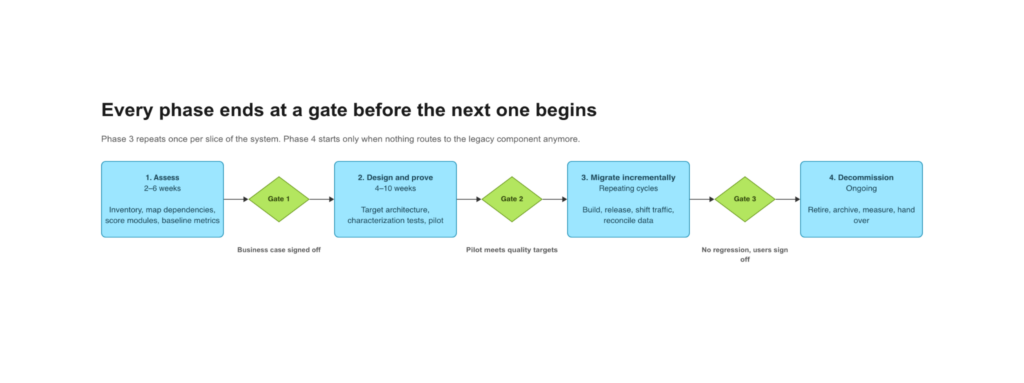
Phase 1. Assess (typically 2–6 weeks)
Goal: evaluate the existing system and know exactly what it costs to keep the system as it is.
- Inventory the system. List modules, integrations, databases, scheduled jobs and the people who depend on each.
- Map dependencies. Trace data flows and calls between components; undocumented integrations are where schedules die.
- Score each module on business value, technical health, security risk and change frequency.
- Baseline the metrics you will improve: run cost, release lead time, incident rate, time to onboard a developer.
Gate: a prioritized list of modules and a business case leadership has signed off.
Phase 2. Design and prove (typically 4–10 weeks)
Goal: choose the target and prove it on something real.
- Define the target architecture and pick an approach per module (encapsulate, replatform, re-architect, replace).
- Write characterization tests that record how the legacy system behaves today.
- Build the routing or integration layer (API gateway, facade or event bus) so old and new can coexist.
- Run a pilot on one low-risk, high-visibility capability and release it to real users.
Gate: the pilot meets agreed performance and quality targets, and the estimate for the remaining phases is updated with real data.
Phase 3. Migrate incrementally (months, in repeating cycles)
Goal: modernize your legacy system without a big-bang cutover, one capability at a time.
- Pick the next slice by value and risk, not by what is easiest technically.
- Build, test against the characterization suite, and release behind feature flags.
- Shift traffic gradually and keep a rollback path until the new component is stable.
- Migrate and reconcile data for that slice; never assume a one-time bulk move will be clean.
Gate per slice: no regression in the baseline metrics, and users have signed off.
Phase 4. Decommission and optimize (ongoing)
Goal: actually turn the old system off and bank the savings.
- Retire legacy components once nothing routes to them; remove their licences and infrastructure.
- Archive historical data in a form that meets retention and audit rules.
- Compare results against the Phase 1 baseline and report them to the sponsor.
- Hand over documentation, runbooks and ownership to the team that will run the new system.
Skipping Phase 4 is the most common and most expensive mistake: the organization pays for two systems indefinitely.
What does it cost to modernize legacy applications?
There is no honest single number for modernizing legacy software. A small application moved to a supported framework can be a matter of weeks; a core platform with dozens of integrations is a multi-year program, and the system may need several approaches at once. What you can do is understand the drivers, and that is what a Phase 1 assessment prices.
What drives the price
| Driver | Why it moves the cost |
| Size and complexity of the codebase | More modules, more business rules to rediscover and test |
| Number of integrations | Each interface needs mapping, testing and often a temporary adapter |
| Documentation and test coverage | Missing tests must be written before anything can safely change |
| Data volume and quality | Dirty or duplicated data turns migration into a cleanup project |
| Chosen approach | Rehosting costs far less up front than re-architecture or a rebuild |
| Compliance requirements | Healthcare, finance and public-sector work adds validation and audit effort |
| Parallel-run period | Two systems in production cost more until the old one is retired |
How geography and team model affect it
Engineering rates differ widely by region. Teams in Central and Eastern Europe are often priced well below U.S. or Western European in-house costs while working in overlapping time zones, which is why many companies use a nearshore or offshore development partner for the build-heavy phases and keep product ownership in-house. For a broader breakdown, see our guide to custom software development costs.
An honest caveat
Cheaper is not automatically better, and expensive is not automatically safer. The lowest hourly rate can produce the highest total cost if the team lacks experience with your legacy stack and spends months learning it. Compare proposals on total cost of ownership, the realism of the phase plan, and evidence of similar migrations, not on rate cards alone.
Making legacy modernization stick: three best practices
Go-live is not the end of the legacy modernization journey. Without discipline, today’s modern system becomes tomorrow’s legacy.
Treat tech debt as a budget line, not a backlog wish
Reserve a fixed share of every release cycle for debt reduction and track it like any other investment. McKinsey’s advice is the same in its research on tech debt: treat it as a business issue, give it dedicated resources, and make the trade-offs visible to business leaders.
Give every system a business owner and a technical owner
Ownership gaps are how legacy systems are born. Assign both owners per component, hold regular architecture reviews, and keep decision records so the next team knows why things were built the way they were.
Measure what you promised
Track the Phase 1 baseline metrics every quarter: run cost, release lead time, incident rate and onboarding time. If they stop improving, revisit the roadmap before drift becomes debt. Automated testing and CI pipelines, which we cover in our approach to quality assurance with continuous integration, keep those numbers honest.
Conclusion
Legacy systems rarely collapse overnight; they get slower, riskier and more expensive one quarter at a time. The answer is rarely a heroic rewrite or replacing the system in one go. Successful modernization of legacy systems is a sequence of small, proven moves, each with a gate that lets you stop, adjust or speed up, until the old system can finally be switched off.
If you want a second opinion on where to start, contact Abto Software. We’ll review your system, outline a realistic first phase, and tell you plainly if a lighter approach would serve you better.
FAQ
It depends on scope. Assessment and a first pilot usually fit within one to four months. Migrating a large core platform in phases can take one to three years, but the value arrives along the way rather than only at the end.
Yes, and that is the main reason to choose phased modernization. A routing layer lets old and new components serve users side by side, so each capability is switched over only after it is proven, with a rollback path in place.
Rewrite only if the system is small, well understood, or its business logic is no longer worth keeping. For large systems with years of embedded rules, incremental re-architecture usually carries less risk, because the old system keeps working while you learn.
Undiscovered behavior, one of the classic challenges in legacy work: business rules, edge cases and integrations that nobody documented. Characterization tests and an early dependency map are the cheapest insurance against surprises in production.
Anchor it in numbers they already track: current run cost, time spent on maintenance, release frequency, security findings and upcoming end-of-support dates. Then show what the first phase will change and how you will measure it.
They can accelerate code analysis, documentation and parts of language conversion. They do not replace architecture decisions, testing or senior review, and their output still needs verification before it reaches production.






 CLUTCH