ASP.NET MVC vs ASP.NET Core MVC – What to Choose for Web Development?

We compare two frameworks – ASP.NET MVC and ASP.NET Core MVC – for modern-day web development ASP.NET MVC remains mature, and ASP.NET Core MVC is cross-platform and optimized for cloud and scaling. The latter has advanced built-in features, dependency injection, and more, for modern, high-traffic applications.
Despite some minor challenges, ASP.NET Core clearly surpasses the old MVC framework.
What is your opinion on the ASP.NET MVC? In the following article, we collected the most detailed information on the disputed framework. Learn more about the significant differences between ASP.NET MVC and other popular models. Get a better understanding of the main advantages the framework can provide, and more.
As an ASP.NET web development company, we know exactly what we are talking about.
What is ASP.NET MVC?
ASP.NET MVC is a web solution development framework by the Microsoft Corporation, released back in 2009. It is an alternative to the Web Forms coding model for building web applications.
The framework allows to rapidly build robust and scalable enterprise-class web applications, dynamic websites, interactive pages, and services. It supports HTML/JS, WML and XML, VB.NET, C#, J#, JScript.NET, and Microsoft Visual Studio. The framework inherited the best features of ASP.NET. Worth mentioning is the powerful server technology built on the basis of Common Language Runtime (CLR).
ASP.NET MVC does also provide the Model View Controller architecture, which is an advanced design pattern. It is usually used for user interface development. The Model View Controller (MVC) in the ASP.NET MVC divides the web solution into three separate components – Model, View, and Controller. After that, the MVC architectural pattern defines the interactions between these components.
The framework was formerly a popular choice among software developers for programming web applications and services. Such apps are easy to build, debug and also deploy. Some of the biggest international companies have their heavy-trafficked websites written on this framework. These include Microsoft, Ikea, Volvo, Stack Overflow, etc.
Is the ASP.NET MVC still relevant in 2025?
ASP.NET MVC is no longer in active development. The last version update was in November 2018. Despite this, a lot of projects are using ASP.NET MVC for web solution development. As to JetBrains’ research, 42% of software developers were using the framework in 2020.
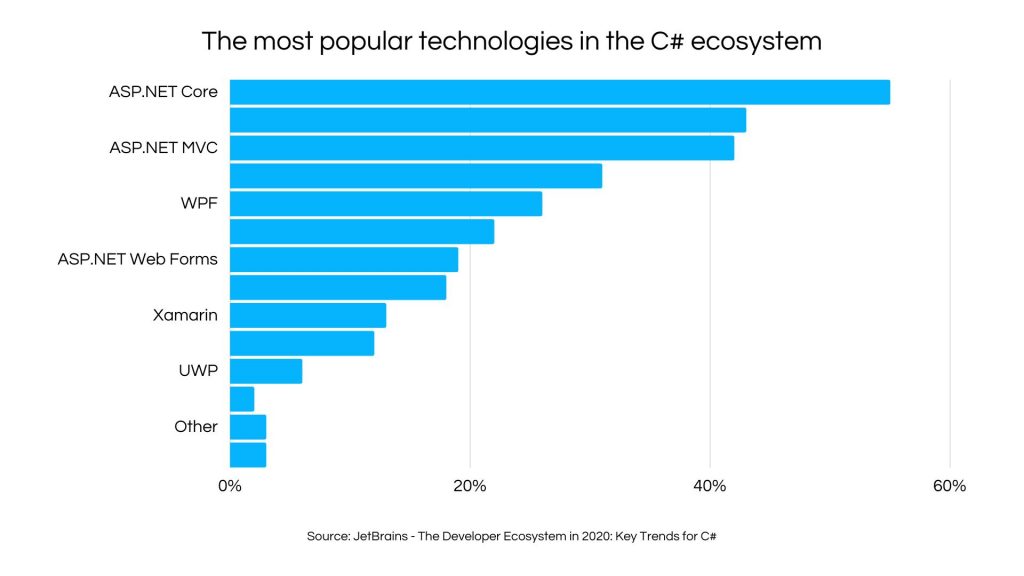
Speaking about ASP.NET Core and ASP.NET Core MVC, more and more professionals are turning to the optimized version. According to Statista data, 31,5% of software developers were using this framework in 2021.
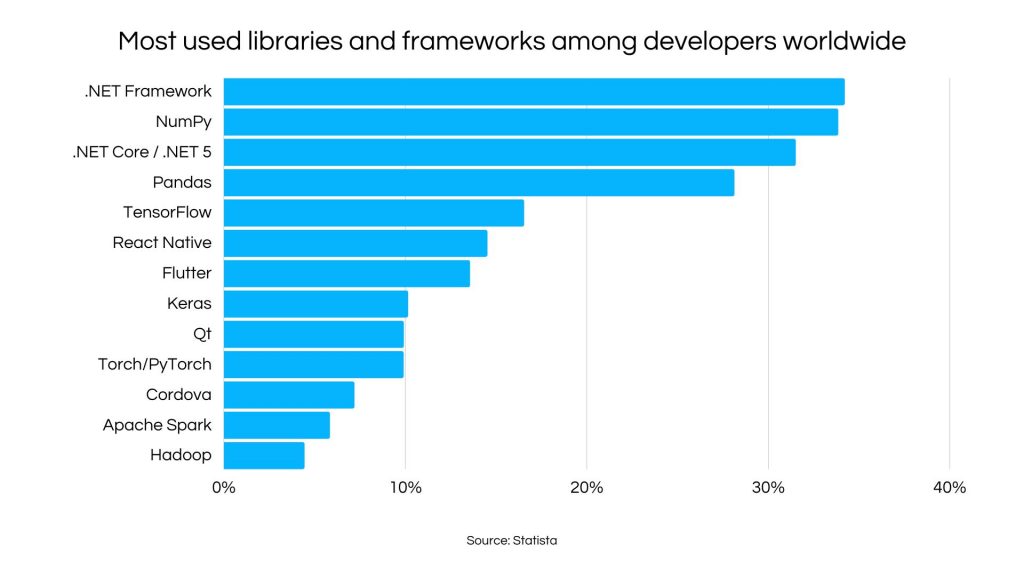
In 2025, ASP.NET MVC still remains a mature, maintenance-only framework – its last release shipped in 2018. At the same time, ASP .NET Core MVC has firmly displaced the framework as the default platform for modern web development.
In overall market share:
- ASP.NET MVC still commands about 4,7%
- While the ASP.NET Core enjoys 2,1%
What is ASP.NET Core?
ASP.NET Core is a cross-platform framework for building more contemporary, internet-connected applications. As a successful evolution of the ASP.NET framework, it was primarily built to support the demands of today’s business environment, mainly focusing on performance, flexibility, scalability, and modularity.
It’s most important aspects:
- ASP.NET Core can run on different operating systems, thus providing cross-platform compatibility
- It uses .NET Core as its runtime engine, thereby making it versatile
- The framework includes the ASP.NET MVC, Web API, Razor Pages, and more
- It is highly modular, which allows to include only the necessary packages
When to choose ASP.NET Core MVC for web development
To achieve high performance and scalability
- ASP.NET Core is one of the fastest frameworks if according to benchmarks
- Lightweight runtime, async-first APIs, and reduced memory usage – perfect combo for microservices and applications that handle high traffic
To obtain cross-platform flexibility
- ASP.NET Core runs across different systems (Windows, Linux, and macOS)
- You can easily deploy to Docker/Kubernetes or a serverless platform (AWS Lambda, Azure Functions)
When starting a modern, cloud-first application
- A built-in Azure/AWS/GCP integration
- First-class support for capabilities, which include app settings, secret management, and seamless, cloud-native logging (Serilog, OpenTelemetry)
To access both modularity and customization
- Middleware-based architecture allows building exactly what you need
- You can plug in only what your app really requires, improving performance and maintainability
ASP.NET CORE vs ASP.NET MVC dive-in: key differences
ASP.NET Core is a completely free web framework released back in 2016 by the Microsoft Corporation. That is, this framework was brought to market 7 years after ASP.NET was launched. ASP.NET Core is an updated version of the outdated framework. Worth mentioning is that it is also cross-platform.
The new Microsoft framework is perfect for building web solutions, console or desktop applications, which can be deployed in any operating system. But there’s even more to the modern framework. It provides for smooth cloud development and deployment.
The core difference between ASP.NET and ASP.NET Core lies in the modern cross-platform approach. The new, updated framework can be used on Windows, Mac or Linux.
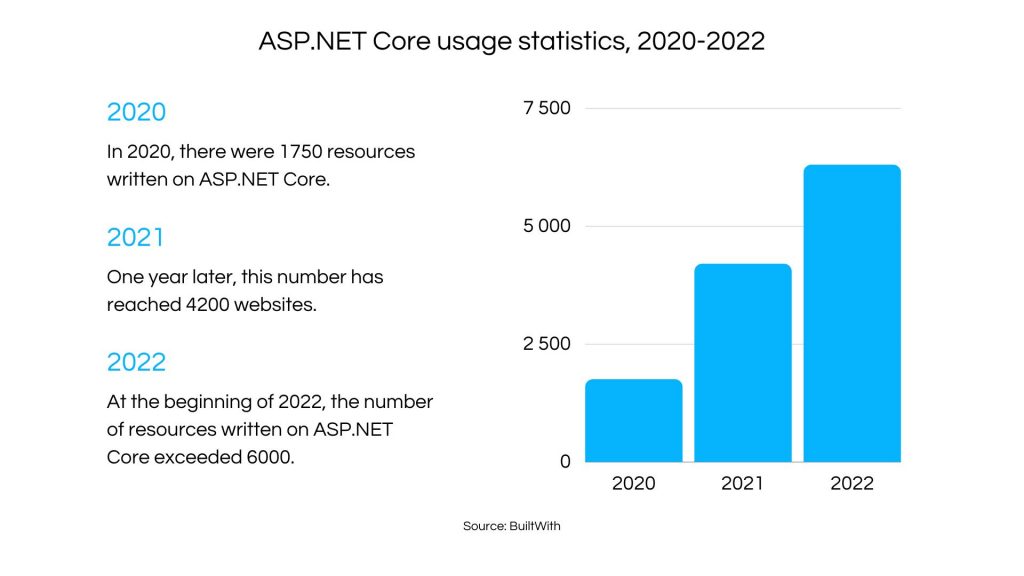
ASP.NET Core’s popularity is rapidly growing. In 2020, there were 1750 resources written on ASP.NET Core, according to BuiltWith’s statements. But that wasn’t the limit for ASP.NET Core. Just one year later, this number has reached 4200 websites.
ASP.NET CORE vs MVC: key features
The MVC coding model is great for building web applications and APIs. It is also optimized to be used with ASP.NET Core. The frameworks used with the MVC programming model are open-source, lightweight, and highly testable. They utilize the latest web standards and support TDD-friendly development.
Speaking about the significant differences between ASP.NET MVC and ASP.NET Core MVC, one should focus on ASP.NET and ASP.NET Core as two framework versions. As we mentioned before, the MVC programming model can be easily used with both, so it isn’t a major factor to consider.
Let’s have a look at the main features of the framework versions:
| ASP.NET | ASP.NET Core | |
| Platform Support | Windows only | Windows, Linux and Mac |
| Architecture | Based on the modern .NET Framework | Based on .NET Core |
| Components | Web Forms, MVC and Web API | MVC, Web API, Razor Pages, and Blazor |
| Dependencies | Less control over dependencies | Strict control over dependencies |
| File support | WCF, WF, WPF, VB, Web config, and more | No support for Global.asax, Web config |
| Visual Studio | Support of all versions | Support of latest versions from 2015 |
In comparison, the updated framework version undoubtedly wins the competition. Especially if the product being developed is multi-platform.
Main advantages of using ASP.NET Core
Improved performance
The quality of the application’s performance is one of the main factors to consider when choosing a framework for web solution development. ASP.NET Core’ main advantage over ASP.NET is speed.
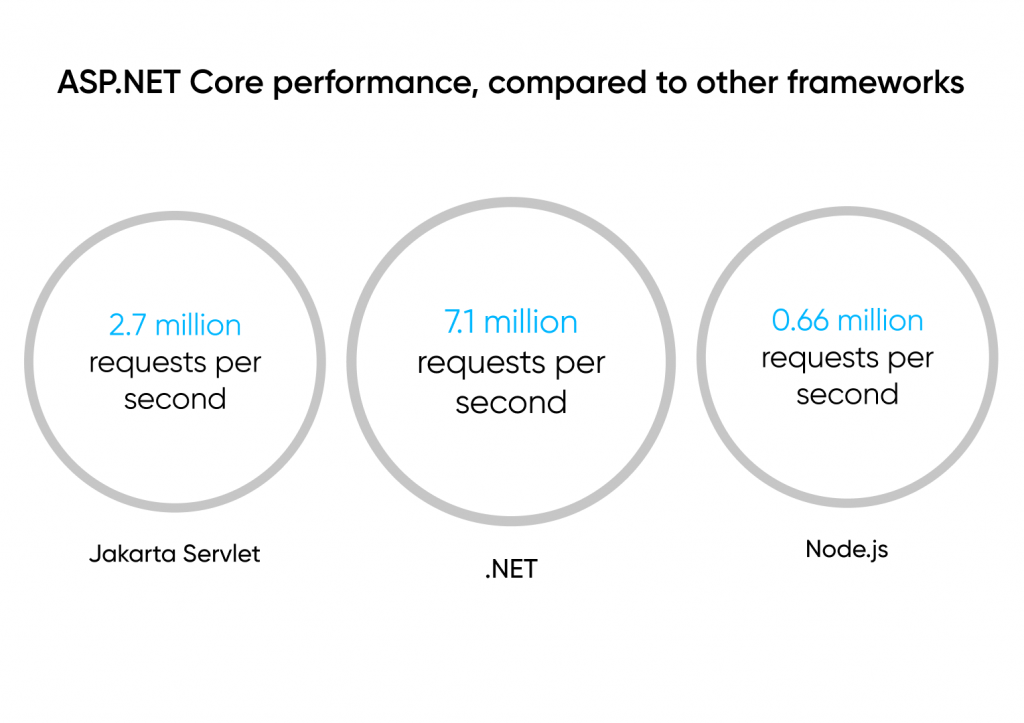
According to Microsoft’s statements, ASP.NET Core can handle more than 7 million requests in one second. Jakarta Servlet (a Java server component) can handle only about 2.17 million requests in the same time period.
Cross-platform support
An ASP.NET development company is the right choice to contract for providing cross-platform support.
When working on web application development, it is immensely important to make sure the designed solution is functioning equally stable on any popular platform. ASP.NET Core is cross-platform and allows built solutions to run smoothly on Windows, Linux, and Mac.
Easier maintenance
As professionals that provide wide-ranging ASP.NET development services, we ensure easier maintenance.
Adding to the previously mentioned advantage, less code means also easier maintenance. The code can be easily optimized when using ASP.NET Core.
Support of cloud-based web application development
As experts in providing full-cycle ASP.NET development outsourcing, we enable cloud-based capabilities, another significant business advantage.
Cloud-based web application development is the perfect approach for businesses ready to scale significantly. ASP.NET Core provides for great flexibility, accessibility across different devices, easier integration, and better data protection.
Minimal APIs
One of the most important improvements of the updated version is the support of minimal APIs. Minimal APIs are the perfect choice to be used with ASP.NET Core to include minimum files, core features and dependencies.
Razor Pages and Blazor
Razor Pages are new to the popular framework. This is a page-based coding model that helps creating better user interfaces. Razor Pages ease page application management as every single page has its own code. This is an approach, which provides for more organized development and, accordingly, simplified deployment.
Blazor is a free open-source framework, which allows software developers to build interactive UI’s using C#, share server-side and client-side app logic written in ASP.NET Core, render UI’s as HTML and CSS, and deliver hybrid applications with .NET and Blazor. Blazor is built on a common language set and is very easy to use.
Dependency injection
Dependency injection is used to integrate the design into the built application. Thanks to the cross-platform ASP.NET Core, software developers can enjoy improved testability and extensibility.
Here’s the difference between ASP.NET and ASP.NET Core:
- The first doesn’t contain a built-in DI container That means the engineers have to plug in external ones (Autofac, Simple, Injector, Ninject).
- The second does contain a built-in DI container This eliminates the need to install external containers and makes the development much easier.
Rapid Development
Rapid Development is perfect for projects with rather short deadlines (2-3 month). This approach allows to focus more on prototyping and development rather than on planning. Rapid Development provides flexibility and adaptability, reduces overall project risks, manual coding, and errors. Speaking about ASP.NET Core, it can be easily combined with this model.
Better portability
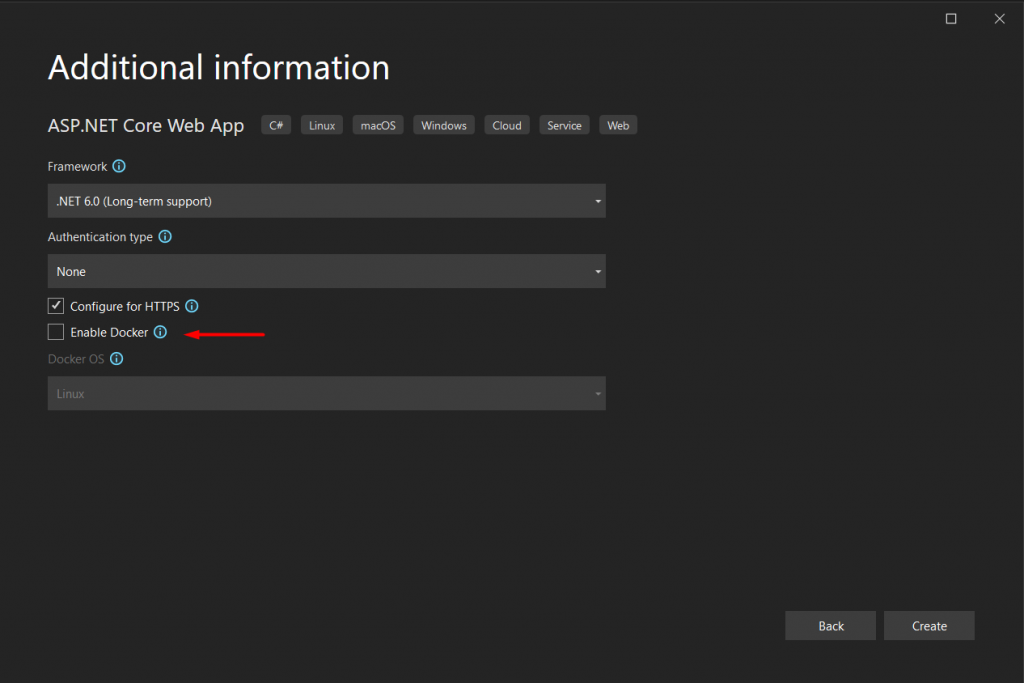
Increased portability means cost-efficiency. ASP.NET Core allows moving designed applications between servers and being completely independent. The platform that provides that portability is Docker. It should be enabled when creating a new ASP.NET Core web application.
Better security
ASP.NET Core has several built-in features that allow to create highly secure web applications. This allows engineers maintaining HTTPS enforcement, XSRF/CSRF prevention, authentication, authorization, and great data protection.
Support of JavaScript frameworks
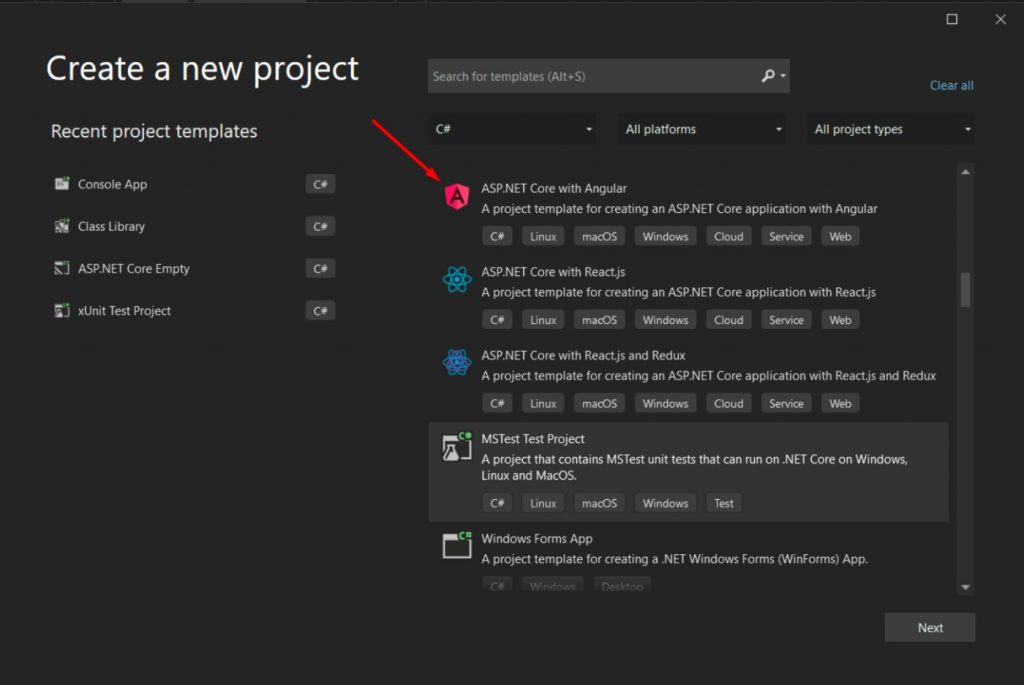
ASP.NET Core offers convenient built-in templates of the most popular JavaScript Frameworks, including React and Angular. This makes the process of creating user interfaces, templating, modularization, API handling notably faster.
Open-source environment
Open-source means software developers working with ASP.NET Core have access to repositories in GitHub. Community members can work on the technology’s improvement and modify it according to their own needs.
Hosting
A new web application built on ASP.NET Core can be easily deployed to a hosting environment. To forward requests to the application, one must set up a reverse proxy server.
Scalability
Along with good performance, web applications built on ASP.NET Core are scalable. That is, the API of the delivered app can deal with more harsh requests before it slows down.
Main disadvantages of using ASP.NET Core
ASP.NET Core is a modern-day framework with strong cloud integration along with cross-platform support. Despite providing essential capabilities, its adoption includes trade-offs in the ecosystem completeness, learning investment, feature coverage, deployment complexity, and more.
Key disadvantages:
Legacy support
- No built-in legacy support for WCF, Web Forms, or Windows Workflow Foundation
- .NET Framework application migration can include major changes
Learning curve
- Middleware pipeline, dependency injection, and the hosting model differ significantly
- Requires more upfront understanding of configuration and environment
Problematic compatibility
- Some libraries don’t work in the ASP.NET Core
- System.Drawing API, Registry access, or certain security models are unavailable
Complex deployment
- Advanced tools and commands (like dotnet-dump) may feel less intuitive
- Linux/macOS debugging is not as seamless as on Windows OS
How we can help
ASP.NET web application development enjoyed popularity for its great reliability and stability in the older days. In 2016, the already outdated framework was replaced by the up-to-date technology ASP.NET Core that offers modern capabilities.
Partner with Abto Software, a provider who has the knowledge and experience to implement ASP.NET Core.
Our services:
- AI development
- RPA services
- .NET development
- ASP.NET development
- Web development
- Mobile development
- Cloud services
- Custom product software development
Our expertise:
FAQ
ASP.NET MVC, as part of the .NET platform, still remains supported under the lifecycle of the .NET framework. But, however, new features are not being developed, and it’s not part of the .NET Core/5+.
To obtain long-term sustainability, we recommend migrating to ASP.NET Core.
The migration will involve several steps:
- Application assessment and audit to check for dependencies, unsupported APIs, and more
- Business logic core extraction into reusable .NET Standard to separate web logic
- Web layer code migration, as such a migration is not a 1:1
- Partial automation by using popular tools to guide the process and automate code portions
It’s a gradual approach that requires both planning and testing, but sets your solution up for the future.
The benefits are vast:
- Better performance and scalability
- Cross-platform support
- Active development and support
- Cloud-native support
- Modular architecture
- Modern tools (Razor Pages, Hot Reload, and more)
In short, ASP.NET Core is faster, more modern, and built for today’s cloud and container-driven environments.





 CLUTCH