Legacy systems in healthcare: RPA workflows before replacement?

As reported by HIMSS, nearly 73% of surveyed healthcare organizations still rely on outdated legacy software. And here’s the catch: to replace those leaves healthcare providers with risks they cannot really afford.
Maybe automation is the first step?
Legacy systems have been declared “dead”, yet continue to handle mission-critical processes across operations. Appointment scheduling, patient registration, billing, insurance, and everything in between across departments – legacy systems are old and imperfect, but also too important to get rid of.
But what if replacing is the bigger risk?
What are legacy systems?
Legacy software, to paint a more vivid picture, is similar to the building blocks of decades-old hospital buildings. It is not modern but carries enormous weight (scheduling, records, laboratory results, pharmacy management).
That doesn’t necessarily make it worthless – in fact, it is specifically designed to handle one thing really good. The problem is that the industry is changing a lot faster than legacy technology that stands behind everything.
Legacy software wasn’t built for connectivity, and that is why it does not meet the modern-day hospital needs. To date, a provider is expected to exchange data across various organizations and meet stricter requirements (a lot to handle without having the tools).
That’s where many inevitably get trapped – they know legacy technology is aging, but replacing is not that easy. So, what’s the solution (if there is one)?
What risks legacy systems come with
Security risks
Most healthcare legacy systems are lacking security updates and patches, making them extremely vulnerable. An incident (phishing, ransomware, data breaches, data theft and loss, and other widespread vulnerabilities) might cause operational disruption, reputational and financial damage, and even regulatory consequences.
Interoperability issues
Older healthcare legacy systems may use outdated protocols that impede data exchange between programs. This hinders efficient communication and collaboration between providers and deteriorates patient care.
Manual processes
Legacy programs go hand in hand with traditionally manual processes, often causing cumbersome workflows. That means human error, misallocated resources, degraded productivity, and undesirable patient outcomes.
Regulatory compliance
Legacy programs might struggle to meet industry-specific requirements that advance to address new threats. That means daily disruption, reputational losses, financial penalties, and similar undesirable consequences.
The danger in numbers
How dangerous is it if programs don’t receive regular support, security patches and other critical upgrades? Quite dangerous.
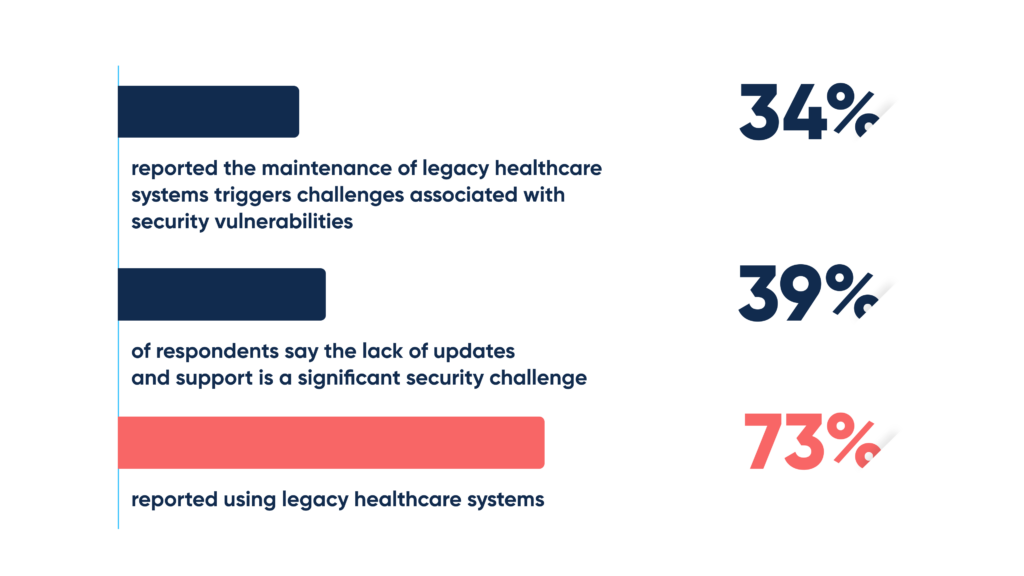
- The majority of respondents – trimming 73% – have reported using legacy healthcare systems
- A quite large proportion – perceptible 34% – has reported maintaining legacy healthcare systems triggers challenges associated with healthcare cybersecurity
Healthcare organizations are typically very laggard and backhanded to address cybersecurity vulnerabilities. That causes inevitable risks – the longer the response to threats, the greater the opportunity to compromise (healthcare infrastructure, network, systems, data, assets).
Usually, under normal circumstances, the respondents reported patching security vulnerabilities in about:
- 1 month for vulnerabilities of low severity rates
- 2 weeks for issues of medium severity rates
- 1 week for high severity vulnerabilities
- 48 hours for critical severity vulnerabilities
Why replacing outdated healthcare systems isn’t the best first step
Embedded knowledge
Legacy platforms rarely exist in isolation – they accumulate business logic, data, workflows, and integrations. Successfully recreating all that is difficult.
Clinical disruption
Legacy platforms don’t get to pause – every “optimization” will affect critical workflows that happen every day. One disruption can ripple across teams.
High cost
Older software is only one part of it – there’s replacing business rules, validation, adaptation, and retraining. The bill goes beyond licensing fees.
Regulatory compliance doesn’t disappear
Older software, if ripped and replaced, must satisfy many requirements: HIPAA, GDPR, HL7, FHIR, and others. Only then it goes into production.
RPA bridging the gap in legacy healthcare software
Rather than replacing systems, RPA works alongside them by automating resource-heavy and rule-based tasks. Without causing any disruption, RPA handles the disconnect.
That solves multiple challenges.
It automates the workflows not requiring human judgement or oversight without changing underlying systems. Data migration, form processing, employee onboarding and offboarding, lead qualification and assignment – the robots can complete everyday tasks human employees are managing – only faster and around the clock.
And even more important, no rushing into expensive, high-risk projects and, potentially, catastrophic damage. The robots simply help to extend the value of already existing systems while preparing for the next steps.
RPAs key use cases (in legacy healthcare systems)
| Administrative processes |
|
| Clinical operations |
|
| Human resources |
|
| Help desk |
|
The moment RPA is not enough (and when to modernize)
Your software is unstable, getting difficult (and expensive) to maintain, and just not meeting the requirements? Your software is outdated.
Some day (rather sooner), you’ll have to stop to bridge the gaps and start to address the deeper business issues.
Be honest with yourself: is automation really resolving the problem or are you automating around bottlenecks? If every new workflow comes with another workaround and integrations become fragile, the issue isn’t efficiency.
And that’s the moment where automation will shift to being one part, not the entire backbone for everything. And that means efficiency, innovation, resilience, and growth over time.
Our proven RPA expertise: real-world results
A legacy RPA overhaul without rebuild
A monolithic RPA platform was causing serious trouble in terms of maintenance and meeting evolving needs. Any updates and patches, expansions, integrations, and changes being made only introduced more complexity and disrupted daily workflows.
The solution we implemented:
- A standalone SAP component
- With modern, extension-based architecture
In some business scenarios, the strategy to follow isn’t replacing what’s working, but removing what’s not.
The results we achieved:
| The before | And after |
|
|
An enterprise RPA modernization: stabilization, scaling, and more
An enterprise RPA platform was becoming increasingly difficult to support, which restrained business growth. The support and maintenance were wasting enormous resources in vain.
The solution (in brief):
- Cross-platform automation
- Plugin-based infrastructure
We did not add new features – we removed everyday friction.
The result we achieved:
| The before | And after |
| Critical upgrades taking months to finish | Critical upgrades in days without overhead |
How we can help
Legacy systems are not the enemy – the problem is allowing those systems to dictate how things are managed. No matter your next big move (if automation or modernization, or both), the success will come from knowing where change can add more value.
We don’t go after flashy labels – we automate and modernize what matters without disrupting what works.
Our expertise:
Our services:
FAQ
Legacy systems (in a common definition) in healthcare are programs that rely on already outdated technology. These support mission-critical workflows – appointment scheduling, patient registration, billing, insurance – but struggle with meeting modern needs.
If that is something you are dealing with, go choose the provider with clients from the healthcare industry.
Legacy systems are a common thing in almost every department – they are being used for many different tasks. This involves different workflows within administration & clinical.
If that sounds familiar, give us a call – we are the vendor you’d choose to handle healthcare technology.
Such systems often depend on repetitive, manual processes that slow down teams and restrain further growth. They might be forcing your personnel to copy and paste data across multiple systems and cause more risks (inconsistences, duplications, and more).
Simply moving patient records is routine, so treat it accordingly.
Outdated systems often struggle with interop, which causes a range of problems: errors, delays, high workload. What’s more, they’re struggling to meet the changing regulatory requirements (security protocols in particular).
If there is no vendor support, let go.






 CLUTCH