
AI-based online shopping assistant
Project summary
We delivered a platform that guides the customers through catalogs through balanced, natural conversation. The results: a longer session duration, a higher conversion rate, and cut manual effort by 60% right away.
Studies indicate that 83% of consumers are much more likely to buy when offered personalized guidance – why not do that?
Services:
Project overview
Our client – a retailer of outdoor sports equipment – was facing the struggle of retaining first-time customers. The slow, never-ending browsing and scrolling through products was tainting the overall shopping experience, which made some visitors simply leave the website.
In commerce, it’s a quick sale or a lost lead, but coaching human consultants is slow and costly – what do you do?
We designed a custom AI online shopping assistant to become a reliable and informed in-store consultant. Personal recommendations, practical advice, and insights on products without wrestling with filters and lists – all combined in one AI personal shopping assistant.
And, behind the scenes, our platform has cut manual efforts by 60%, freeing salesmen to focus on strategy.
Main goals
- Less noise: no duplications of items
- A faster result retrieval
- A natural dialog flow
- And, no less important, a scalable, white-label-ready platform to deploy across brands without stress
How the solution works
The intelligent shopping assistant is built to guide the customer through catalogs by keeping up conversations. No filters or lists, just natural, intuitive interaction to receive personal suggestions, some advice, or education – all automatically, no overload.
The online shopping assistant is using a tool-use agent architecture with an LLM model as the reasoning engine. It interprets the intent and context, dynamically calls specialized tools – search, comparison, and education – and provides accurate responses.
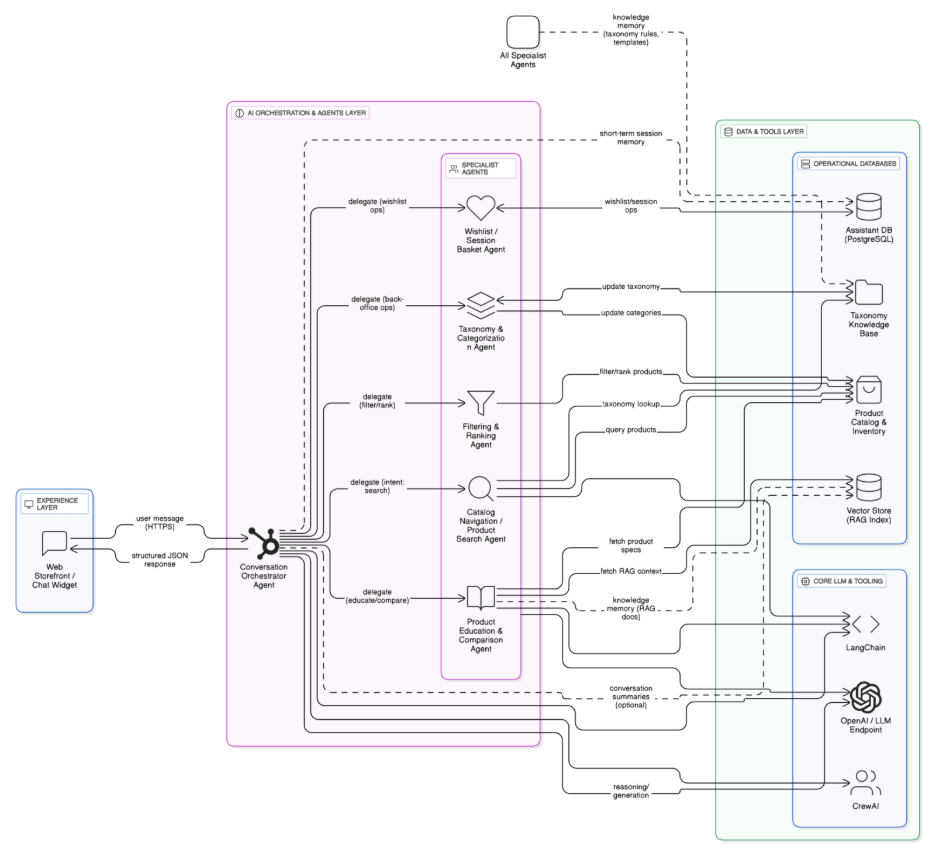
AI-powered online shopping assistant: a tool-use agent architecture with an LLM model as the reasoning engine – by Abto Software
Our system is developed to converse and simulate human expertise in real-time, not analyze specific behavior. This allows the assistant to mimic an in-store consultant who knows the inventory and features of products, which drives confident decisions.
The result: a seamless, personalized experience even within large catalogs.
Key features
- AI for product search & filtering
- AI for product education & comparison
- Advanced categorization
- Conversational flow
AI shopping assistant with search & filtering
- Natural language processing for intuitive interaction between customer & system
- Dynamic result narrowing for quick refinement
- Deep catalog integration for up-to-date search across inventories
- Dual-mode search that combines hierarchical queries & free-text
- Attribute-based filtering (color, size, price, brand, age suitability)
AI shopping software with education & comparison
- AI-based education to explain the differences between items
- LLM-based comparison to support insight-backed decisions
- RAG-based enrichment to leverage external documents or catalogs
Advanced categorization
- Goods categorization to tag and classify available products
- Building tools to create and optimize hierarchical taxonomies
- Catalog indexing to ensure structured navigation and relevant, category-based browsing
Conversational flow- Multi-turn dialogue for guided, assistant-led experiences
- Short-term memory
- Intent-switching awareness
- Context-aware recommendations
- Adaptable tone
Our contribution
We developed the architecture that bridges human-feeling conversation and personalized shopping experience. While mimicking the behavior of experienced human consultants – explaining, comparing, and recommending – our solution also maintains factual consistency by sifting through verified data sources.
Our team was responsible for delivering:
- A tool-use agent architecture
- LLM training and fine-tuning
- An automatic product categorization
- Conversational flows
- The integration of third-party catalog and inventory APIs
- And continuous, post-launch support and maintenance
Main challenges
Complex structures and specifications
One challenge was managing nested categories, variant stock keeping units, and numerous technical attributes while keeping a simple and responsive user experience.
Natural flow throughout interactions
Another challenge was providing context-aware interactions over multiple dialogue turns while adapting to varied intents, tones, and phrasing.
Factual accuracy and consistency across brands
We had to ensure product explanations and comparisons are reliable despite them coming from mixed sources, meaning balancing internal knowledge, brand-provided information, and also external materials.
Authentic feeling, trustworthy interactions
We aimed at building user confidence through guidance that informs without overwhelming, needless details, basically mimicking human advice.
Value delivered to business
The intelligent AI assistant is turning the slow, clumsy browsing and scrolling into smooth, natural interactions. Our trained AI agent makes sure every answer feels appropriate, and suggestions make sense.
For the business itself, this means:
- A longer session duration
- And higher conversion rates
No more dead ends, just clarity – and clarity is what converts visitors into buyers.
What’s more, by introducing an automatic product categorization, we cut manual tagging by more than 60%. That means fewer hours being wasted, no more human error, and much more efficiency – a win in commerce.
Tools & technologies:
Tech stack:
- Python
- Node.js
- React
- PostgreSQL
- crewAI
- LangChain
- OpenAI API
Third-party integrations:
- Product catalog
- Scraping pipeline
- Dialog manager
- Observability/trace logs
- Custom APIs
- Shopify platform
Timeline:
- MVP stage – 5 months
- Further refinement and optimization – 3 months
Team:
- 1 technical lead
- 1 product manager
- 5 software engineers (LLM, NLP, backend, frontend)
- 1 conversation designer



 CLUTCH